
Krill Oil vs. Fish Oil: Phospholipids, Triglycerides, and Why the Milligrams Mislead
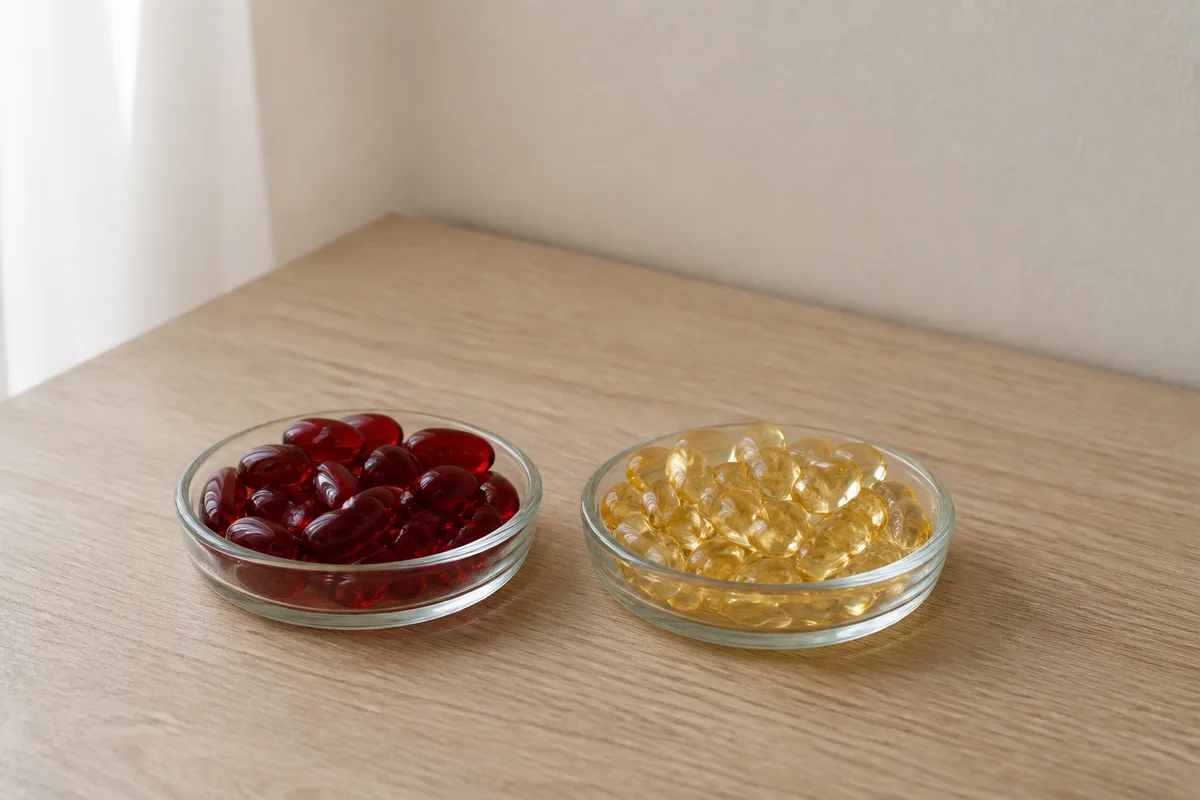
Krill oil and fish oil deliver the same two omega-3 fatty acids, EPA and DHA, attached to different carrier molecules. Fish oil supplies them as triglycerides or ethyl esters; krill oil supplies them bound into phospholipids, which are water-dispersible and generally absorb better per milligram. Krill also carries astaxanthin and choline, and costs considerably more per milligram of omega-3.
Put a krill oil bottle next to a fish oil bottle and the comparison looks settled. The fish oil says 1,000 mg with 300 mg of EPA and DHA. The krill oil says 500 mg with maybe 90. Same shelf, similar price, a third of the omega-3.
The milligrams are accurate. They are also not the whole comparison, and the reason is chemistry rather than marketing.
How the omega-3 is packaged
EPA and DHA are the two marine omega-3 fatty acids of interest. In a supplement they arrive attached to a carrier molecule, and there are three common ones.
Triglycerides: the natural form in fish. Three fatty acids on a glycerol backbone.
Ethyl esters: what most concentrated fish oils actually contain. Concentrating fish oil to raise the EPA/DHA percentage generally converts it to the ethyl ester form. This is worth knowing because ethyl esters are typically less well absorbed than triglycerides, and a "reesterified triglyceride" product has been converted back at extra cost. Plain fish oil labels rarely say which one you have.
Phospholipids: the krill form. Here EPA and DHA are bound into phospholipid molecules, the same class of molecule that makes up cell membranes.
That last one is the substantive difference. Phospholipids are water-dispersible, so krill oil mixes into the aqueous environment of the gut rather than needing to be emulsified the way a pure oil does. Absorption studies comparing the forms generally favour phospholipid-bound omega-3, which is the basis of the claim that krill delivers more per milligram than the label suggests.
Two honest caveats: the size of that advantage varies considerably between studies, and a number of them were industry-funded. It is a real and mechanistically sensible difference, not a settled multiplier. Anyone quoting you a precise conversion ratio is overstating what the literature supports.
What krill carries that fish oil does not
Astaxanthin. The red carotenoid that gives krill oil its colour. It is an antioxidant, and it also serves a practical purpose in the bottle: omega-3s oxidise readily, and naturally present astaxanthin helps the oil resist going rancid. Most fish oils need added antioxidants to achieve the same stability.
Choline. Krill phospholipids are largely phosphatidylcholine, so krill oil supplies choline as a matter of composition rather than addition. Choline is an essential nutrient most people under-consume.
No fishy repeat. Anecdotal but consistent enough to matter, the water-dispersible phospholipid form does not tend to produce the reflux and aftertaste that leads a lot of people to abandon fish oil. Adherence is a real consideration, not a soft one.
Where fish oil wins
Being straight, because krill is not simply better.
Cost per milligram of EPA/DHA. Fish oil is substantially cheaper, and it is not close. If your priority is a high daily EPA/DHA intake, fish oil delivers it for less.
High doses are impractical with krill. Regimens calling for two or three grams of EPA and DHA a day are achievable with concentrated fish oil and would take an unreasonable number of krill capsules.
Some people should not take krill at all. Krill is a crustacean. Anyone with a shellfish allergy should avoid it.
So the honest framing: krill is the better-absorbed, better-packaged, more expensive option at modest doses. Fish oil is the efficient way to get a lot of EPA and DHA cheaply. They serve different priorities.
Reading either label
- Look for EPA and DHA figures, not total oil. "1,000 mg fish oil" tells you the capsule size. The two numbers underneath are what matter.
- Form, if stated. Triglyceride, reesterified triglyceride, ethyl ester, or phospholipid. Most fish oils do not say, which is itself informative.
- Freshness. Omega-3s oxidise. A rancid capsule smells strongly fishy when opened. Some manufacturers publish a peroxide value; most do not.
- Sourcing. For krill, look for a named fishery certification. Antarctic krill is one of the more tightly managed fisheries, but that only means something if the source is stated.
- A named raw material beats a generic description, for the same reason it does anywhere: it ties the product to a specific manufacturer's specifications.
What we make
Pristinium is krill oil, 500 mg of SUPERBA2™ Antarctic krill per softgel, delivering 110 mg of omega-3 fatty acids (60 mg EPA, 27 mg DHA), 200 mg of phospholipids, 25 mg of choline, and 50 mcg of naturally occurring astaxanthin.
Those EPA and DHA numbers are small next to a concentrated fish oil, and this article is the reason we print them plainly rather than leading with the 500 mg. The phospholipid form, the astaxanthin and the choline are what you are actually choosing when you choose krill, not a bigger number.
If you would rather take your omega-3 from fish, OlivOmega pairs wild fish oil with olive oil instead.
If you are allergic to shellfish, Pristinium is not for you: it is krill, and no processing changes that.
These statements have not been evaluated by the Food and Drug Administration. This product is not intended to diagnose, treat, cure, or prevent any disease.