
Bilberry vs. Blueberry: Related, Not Interchangeable
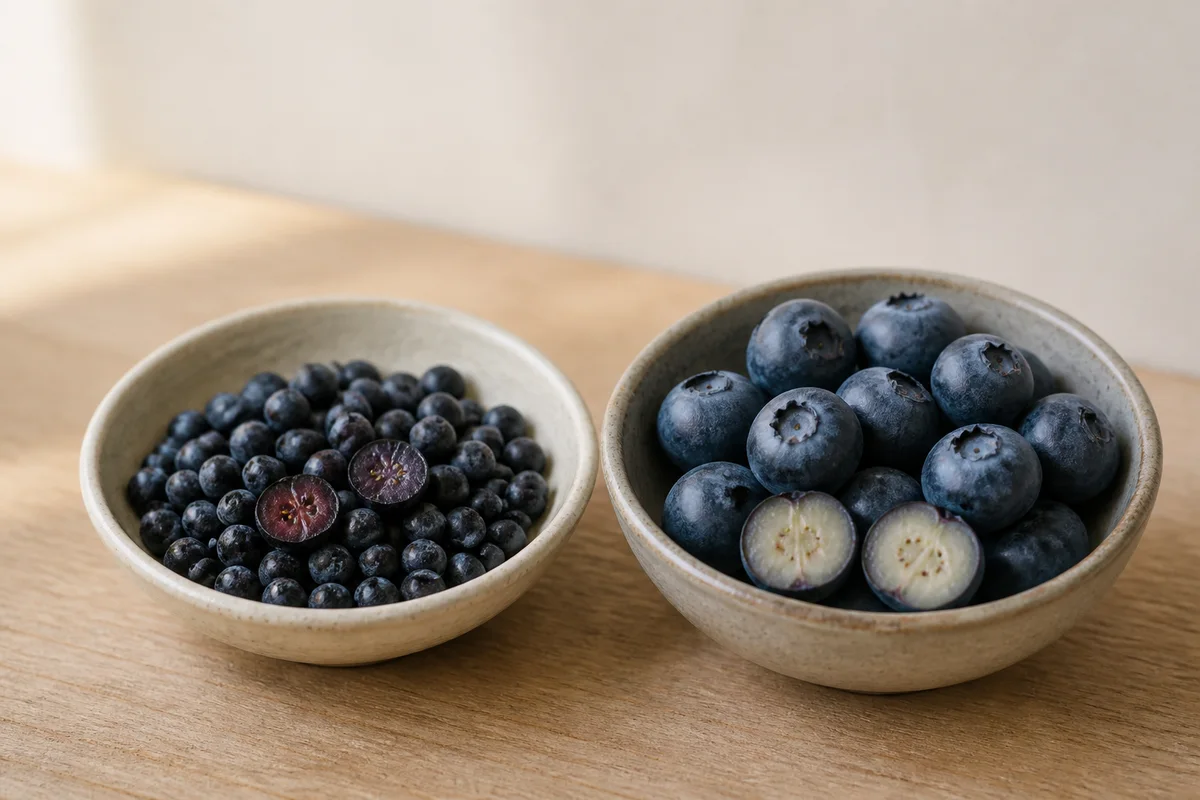
Bilberries and blueberries are different fruits in the same genus, Vaccinium. The practical difference is visible when you cut them: a blueberry has pale flesh with its pigment confined to the skin, while a bilberry is dark red-purple throughout. Because that pigment is the anthocyanin content, bilberries carry more of it per gram.
Bilberry and blueberry look close enough that the words get used interchangeably, especially on supplement labels. They are genuinely related, same genus, Vaccinium, but they are different fruits, and the difference is visible if you cut one open.
Cut them in half
A blueberry is pale inside. The skin is deep blue-purple; the flesh is greenish-white. All the pigment sits in the skin.
A bilberry is coloured all the way through. Dark red-purple flesh, which is why bilberries famously stain fingers and mouths and blueberries mostly do not.
That single observation is the whole practical distinction, because the pigment is the compound of interest. The colour comes from anthocyanins, a class of flavonoid polyphenol responsible for red, purple and blue tones across the plant world. A fruit pigmented throughout carries more of them per gram than one pigmented only at the surface.
Bilberries also typically grow singly on low wild shrubs rather than in cultivated clusters, and they are smaller, softer and harder to harvest, which is why you rarely see them fresh in a shop outside northern Europe, and why they cost more as an extract.
Wild versus cultivated matters too
There is a second axis that gets less attention than the bilberry/blueberry split and may matter as much: wild versus cultivated.
Wild berries are generally smaller, with a higher skin-to-flesh ratio and more concentrated pigment. Cultivated highbush blueberries have been bred over decades for size, yield, shelf life and sweetness, sensible commercial goals, none of which is anthocyanin density. A large, mild, cultivated berry is typically less pigment-dense per gram than a small wild one.
So "wild blueberry" on a label is a meaningful specification rather than decoration, in the same way "bilberry" is.
What anthocyanins actually are
Anthocyanins are water-soluble pigments in the flavonoid family. In the plant they serve as pigment and as protection against UV and oxidative stress. In laboratory settings they demonstrate antioxidant activity, which is the basis of the interest in them.
Two honest caveats.
They are poorly absorbed, only a small fraction of ingested anthocyanins appears in blood as the intact compound, and much of what arrives in the colon is metabolised by gut bacteria into smaller phenolic compounds. Some researchers think those metabolites do much of the work, which would mean the intact molecule is not the whole story.
And antioxidant activity in a test tube is not a health outcome. ORAC scores and similar assays measure what a compound does in a dish, and the USDA withdrew its own ORAC database in 2012 specifically because the values were being misapplied to imply human benefits they did not support.
The eye question
Bilberry has a persistent association with vision, usually attached to a story about RAF pilots in the Second World War eating bilberry jam to improve night vision. It is a good story. It is also widely considered wartime misdirection, cover for the introduction of airborne radar, and controlled trials of bilberry for night vision in healthy people have largely not supported it.
There is a real research literature on anthocyanins and eye health, and it is not nothing. But it is a long way from settled, and bilberry is not a treatment for any eye condition. If you have changes in your vision, blurring, floaters, loss of night vision, anything that has altered noticeably, that is an optometrist or ophthalmologist appointment, not a supplement decision. Several of the conditions that present that way are treatable when caught and are not when they are not.
Which should you actually eat
For food: eat both, and prefer wild or smaller varieties when you can get them. Whole berries bring fibre and water alongside the pigment, and that combination is not something a capsule reproduces.
For a supplement, the reasonable case is concentration and consistency. A capsule can deliver the anthocyanin content of considerably more fruit than most people eat daily, in a form that does not vary with season or shipping. That is a convenience argument, not a superiority one, a supplement is not better than eating berries.
What we make
Wild Blueberry & Bilberry Antioxidants carries both, rather than choosing between them: wild-harvested Alaskan blueberries and bilberries concentrated into one daily vegetarian capsule.
Wild-harvested and Alaskan are both deliberate, small, deeply pigmented, slow-grown fruit rather than cultivated highbush berries bred for size. It is intended for everyday antioxidant support, and for eye and cognitive wellness as part of a normal diet.
If antioxidant polyphenols are the thread you are pulling on, pure resveratrol covers the other well-known one, including why the milligram number on the front of those bottles usually is not what you think.
These statements have not been evaluated by the Food and Drug Administration. This product is not intended to diagnose, treat, cure, or prevent any disease.