
Pure Resveratrol: What "Pure" Should Actually Mean on the Label
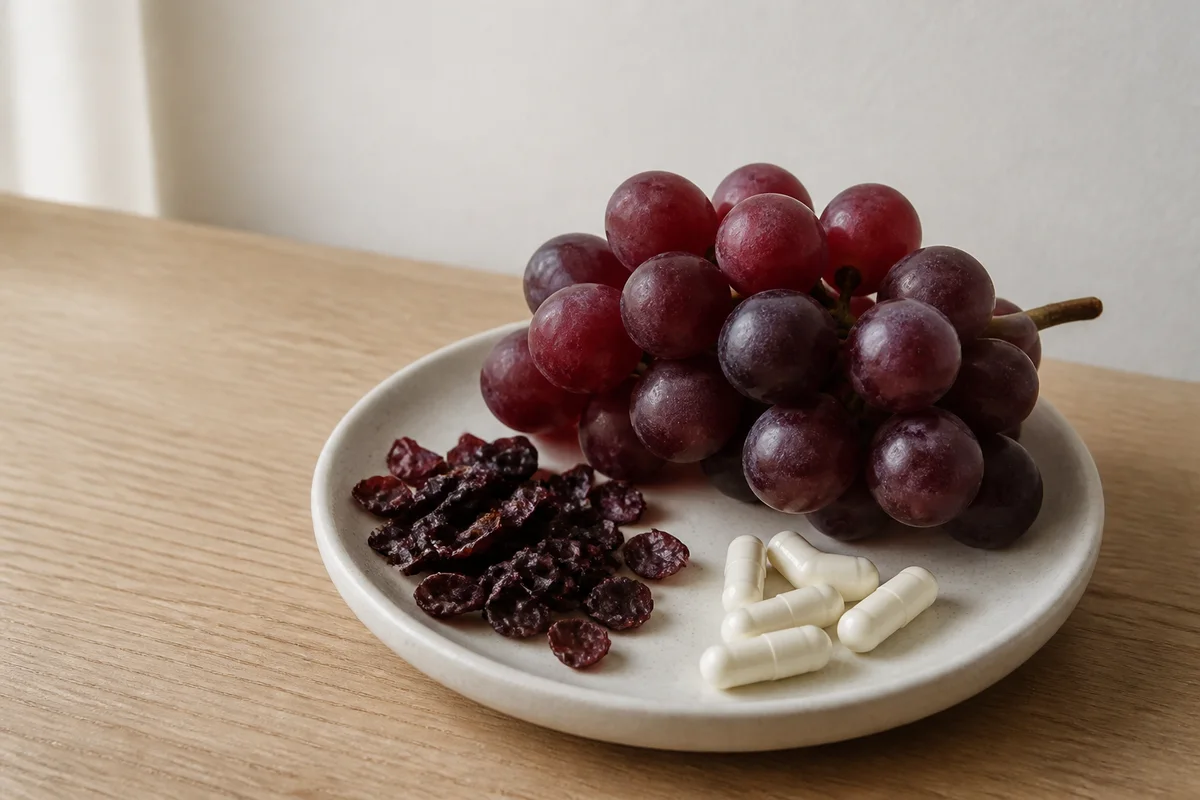
On a resveratrol label, “pure” has to answer two separate questions: which isomer, and pure by what measure. Trans-resveratrol is the form used in human research. The milligram figure on most bottles describes the extract rather than the resveratrol in it, so 500 mg of a 50%-standardised knotweed extract is 250 mg of actual resveratrol.
Resveratrol is one of the few supplement ingredients most people have heard of before they go looking for it. It arrived attached to a good story, the French Paradox, the observation that a population fond of rich food and red wine had lower rates of heart disease than that diet seemed to predict, and resveratrol was the compound singled out for the credit.
Whether it deserved that credit is still unsettled, and we will come back to it. But the story sold a lot of bottles, and the bottles vary enormously.
Two things the word "pure" has to answer
Nearly every resveratrol product uses the word. It can mean two completely different things, and a serious label answers both.
Which isomer? Resveratrol exists as trans-resveratrol and cis-resveratrol. Essentially all the published human research uses the trans form; it is also the more stable of the two. Light and heat convert trans to cis, so a poorly handled or poorly packaged product can drift toward the isomer nobody studied. A label that says "resveratrol 500 mg" without specifying trans- has told you nothing about which molecule you are getting.
Pure by what measure? This is where most of the confusion lives. "500 mg" on the front of a resveratrol bottle usually refers to the extract, not the resveratrol. A common knotweed extract is standardised to 50% trans-resveratrol so 500 mg of extract is 250 mg of the active, and the other half is plant material. Some are 20%. A 99%-pure preparation is nearly all resveratrol by weight.
The arithmetic matters more than the headline number. 50 mg of a 99% material and 500 mg of a 20% extract are not far apart in actual resveratrol, and they are very different in everything else you are swallowing.
Grapes versus Japanese knotweed
Almost all cheap resveratrol comes from Polygonum cuspidatum. Japanese knotweed. It is an invasive weed, it is unusually rich in resveratrol, and it is inexpensive to harvest and extract. That is the whole reason it dominates the category.
The complication is what else knotweed brings. It naturally contains emodin, an anthraquinone with a laxative effect. Well-made knotweed extracts reduce emodin, but the level varies between manufacturers and is rarely disclosed, and it is a plausible explanation for the digestive upset some people report on high-dose resveratrol.
Grape-derived resveratrol is the alternative. It is the source the French Paradox story was actually about, it does not carry emodin, and it is considerably more expensive to produce, which is why it is much less common.
Neither source produces a chemically different resveratrol molecule. The difference is what accompanies it.
What the evidence supports
This is where it is worth slowing down, because resveratrol is one of the most over-claimed ingredients in the entire supplement market.
Established: resveratrol is a polyphenol with antioxidant activity in laboratory settings. It is present in red grapes, red wine, and several berries. Human trials have looked at absorption and short-term markers.
The honest complication: resveratrol has poor oral bioavailability. It is absorbed and then extensively metabolised, so blood levels of unchanged resveratrol stay low. Much of the striking early research was done in cell cultures or in animals at doses far beyond what a person takes.
Not established: that resveratrol supplementation extends life, prevents any disease, or reproduces the epidemiology behind the French Paradox. The resveratrol-as-longevity-drug story ran well ahead of the human evidence and has been walked back substantially since.
So the reasonable position is that resveratrol is a well-characterised dietary polyphenol worth taking for everyday antioxidant support, not a longevity intervention. Anyone selling it as the latter is selling you the 2006 version of the science.
Five things to check on a bottle
- Trans-resveratrol, stated explicitly. Not just "resveratrol."
- Purity percentage. 99% and 50% are both legitimate; only one of them lets you calculate what you are actually taking.
- Milligrams of resveratrol, or of extract? If the label does not distinguish, assume extract and discount accordingly.
- Source named. Grape or knotweed. If unstated, it is knotweed.
- Opaque packaging. Trans-resveratrol is light-sensitive. Clear bottles are a bad sign for a compound that isomerises under UV.
One practical note: resveratrol is fat-soluble, so absorption is better taken with a meal containing some fat rather than on an empty stomach.
What we make
Ultra Pure Resveratrol is 50 mg of resVida® trans-resveratrol at 99% purity, from red grapes, not knotweed, so no emodin comes along with it.
The 50 mg figure looks small next to a 500 mg knotweed bottle, and that is the point of this whole article: at 99% purity it is 50 mg of actual trans-resveratrol, where 500 mg of a 50% extract is 250 mg of resveratrol and 250 mg of plant matter. resVida® is the specific grape-derived material used in published human work, which is why we name it rather than saying "resveratrol extract."
It is intended for everyday antioxidant support and healthy-aging support. It is not a longevity drug and we are not going to describe it as one.
Resveratrol is also one of the four actives in VitalFactors, alongside VitalNAD⁺, EGCG and S.O.D., the NAD⁺ article covers how that side of the formula is put together.
These statements have not been evaluated by the Food and Drug Administration. This product is not intended to diagnose, treat, cure, or prevent any disease.