
Digestive Enzymes vs. Probiotics: Two Different Jobs, Constantly Confused
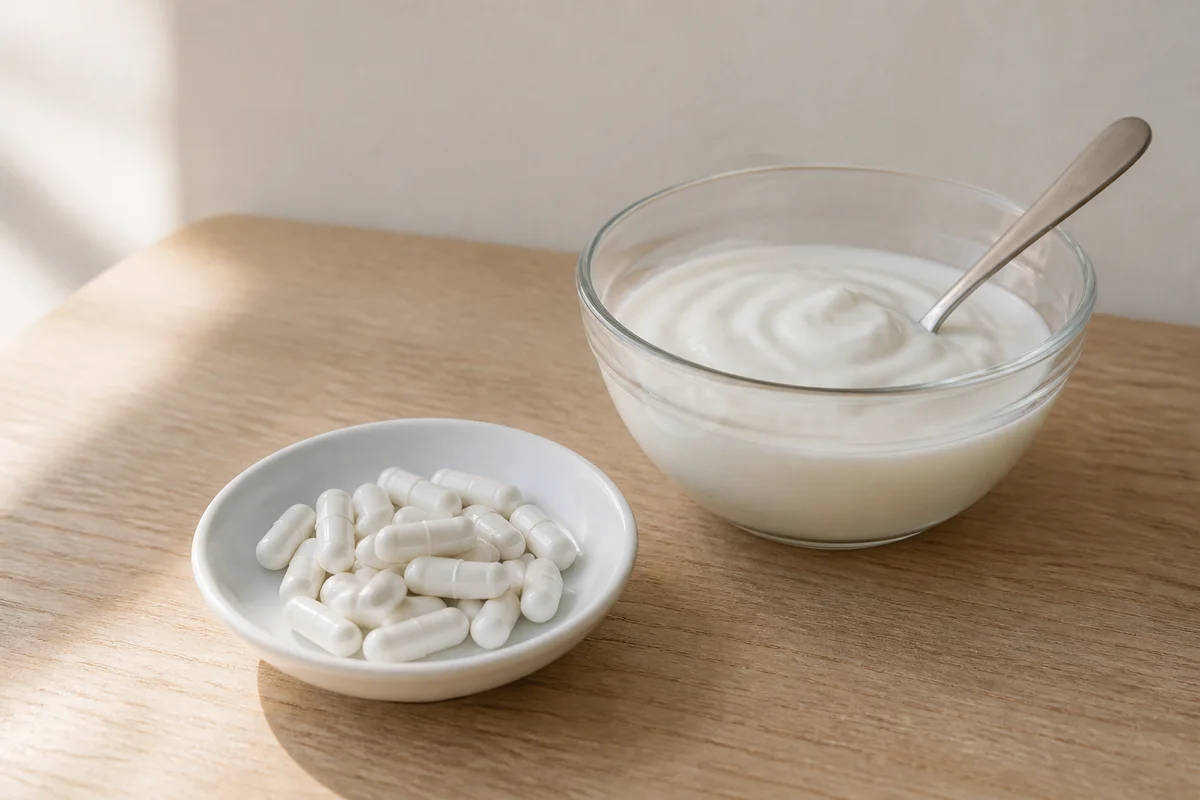
Digestive enzymes and probiotics do different jobs in different places. Enzymes are proteins that break food apart in the stomach and small intestine during a meal; probiotics are live bacteria that travel to the large intestine and join the population already living there. Enzymes work on the meal you take them with; probiotics generally need weeks of consistent use.
These two products sit next to each other in every store, get recommended for overlapping reasons, and do fundamentally different things.
The short version:
Digestive enzymes are proteins that break food apart. They are not alive. They work in the stomach and small intestine, during the meal, and they are used up in the process.
Probiotics are live bacteria. They do not break down your dinner. They travel to the large intestine and take up residence among the bacteria already living there.
Different substances, different locations, different timing, different reasons to take them. Worth understanding before you buy either.
What each one actually is
Enzymes are tools, and they are disposable
An enzyme is a protein shaped to recognize one specific chemical bond and cut it. Lactase cuts lactose. Lipase cuts triglycerides. Alpha-galactosidase cuts the bond in the bean carbohydrates humans cannot otherwise break.
Enzymes are not alive and they do not multiply. Take one with a meal and it works on that meal. Take another tomorrow and it works on tomorrow's. There is no building-up period and nothing accumulates.
They act upstream, mouth, stomach, small intestine, which is where digestion and nearly all nutrient absorption happen.
Probiotics are residents, and they need time
A probiotic is a live microorganism, usually strains of Lactobacillus or Bifidobacterium, that survives the trip through stomach acid and reaches the large intestine alive.
Once there, they join a population of trillions of bacteria already established. They are not primarily digesting your food. They ferment material your own enzymes could not break down, produce short-chain fatty acids, and interact with the gut lining and immune tissue.
They act downstream, in the large intestine, after digestion and absorption are essentially finished. And unlike enzymes, they generally need consistent daily use over weeks before there is much to notice, you are shifting the composition of an established ecosystem.
The differences that actually matter when choosing
Timing. Enzymes are taken with food, with the first bites, because they have to be present while the meal is. Probiotics are usually taken on a consistent daily schedule, and the timing relative to meals matters much less.
Onset. An enzyme either works on the meal you took it with or it does not. Probiotics work on a scale of weeks.
Where they act. Small intestine versus large intestine. This is the cleanest way to keep them straight, enzymes handle getting nutrients out of food; probiotics are part of the ecosystem that handles what is left over.
Whether heat and time destroy them. Probiotics are alive, so viability is a real concern, strain count at manufacture is not the same as strain count at expiry, and some products need refrigeration. Enzymes are not alive; their concern is activity level, which is a different measurement entirely.
What a "good" label looks like. For probiotics: named strains, CFU count guaranteed through expiry rather than at manufacture. For enzymes: activity units per enzyme, not just milligrams. Neither number is interchangeable with the other.
Which one fits which situation
Neither of these is a treatment, and if symptoms are persistent or painful that is a conversation for a doctor rather than a shelf. With that said, the ordinary distinction is reasonably clear.
Enzymes make more sense when the trouble is tied to specific meals. Dairy that reliably disagrees. Beans and cruciferous vegetables. A restaurant meal much richer than what you normally eat. The pattern is that you can name the food, and the discomfort follows it fairly closely in time.
Probiotics make more sense when the interest is general and ongoing rather than meal-linked, supporting the gut microbiome as a background matter, or after a course of antibiotics has disrupted the resident population.
There is no conflict in using both. They act at different points and do not interfere. Enzymes go with meals; probiotics go on a daily schedule.
Two things sold as the same thing that are not
"Enzyme" on a probiotic label. Some probiotic blends include a small amount of enzyme, often at token activity levels. Check the actual units before treating it as an enzyme product.
"Digestive support" as a category name. This phrase gets applied to enzymes, probiotics, prebiotic fiber, herbal bitters, and fiber supplements, all of which work by entirely different mechanisms. It tells you the shelf, not the substance. Read the ingredient panel.
Prebiotics are worth one line of clarification, since the names are so close: prebiotics are food for bacteria, typically fibers like inulin, rather than bacteria themselves. So the trio runs: enzymes break down your food, prebiotics feed your bacteria, probiotics are bacteria.
Where our two formulas fit
Healthy Tract Digestive Enzymes is the enzyme side: eleven plant-sourced enzymes in one capsule, taken with food, covering starches, protein, fat, dairy, and the bean and cruciferous-vegetable carbohydrates human enzymes cannot cut. Every enzyme is printed by activity unit on the panel.
Tummy Probiotics is the other side, live cultures, taken on a daily schedule, working downstream in the large intestine.
They are complementary rather than alternatives, and which one you want depends entirely on whether your interest is meal-linked or ongoing.
If you are still working out which enzymes matter for which foods, which digestive enzyme breaks down what maps that out food by food. For the underlying mechanics, start with what digestive enzymes actually do.
These statements have not been evaluated by the Food and Drug Administration. This product is not intended to diagnose, treat, cure, or prevent any disease.