
What Digestive Enzymes Actually Do: A Plain Guide to the Ones Your Body Uses Most
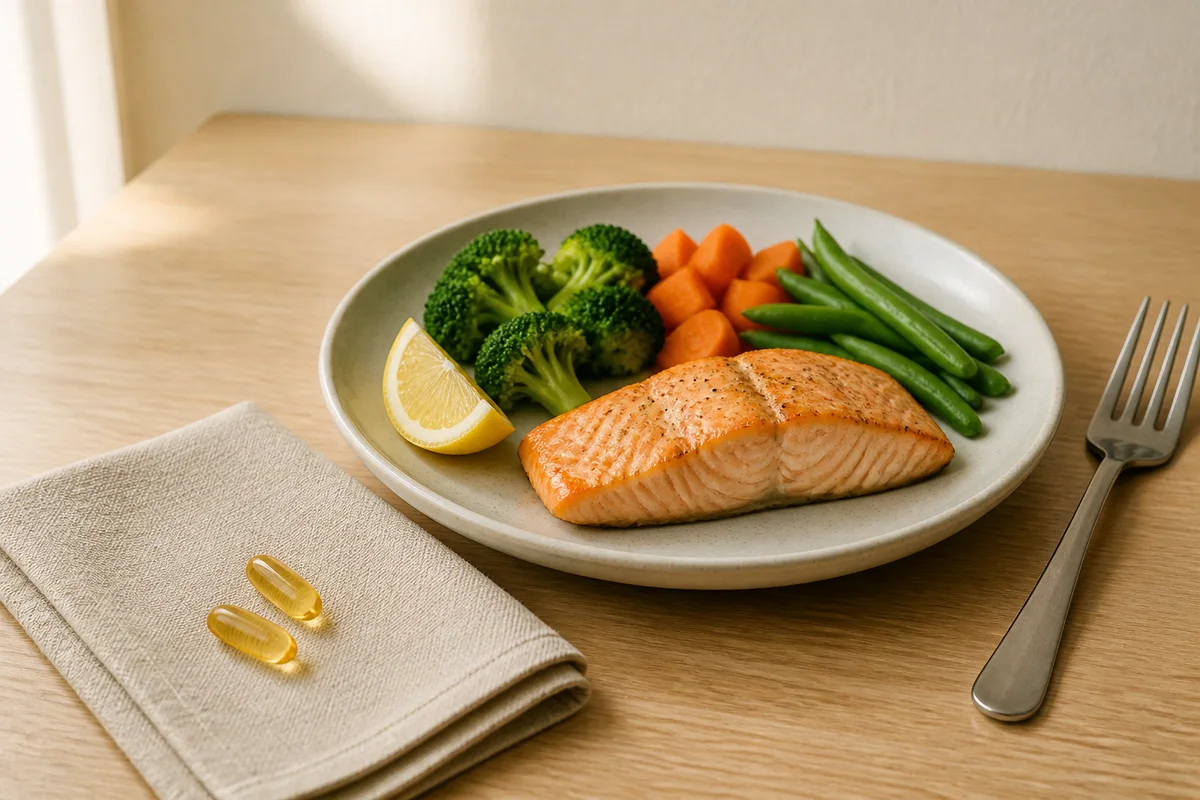
Digestive enzymes are proteins that cut large food molecules into pieces small enough for the small intestine to absorb. The body makes them in the salivary glands, stomach and pancreas, and each type works on one class of food: amylase on starch, protease on protein, lipase on fat, lactase on the lactose in dairy.
Digestion sounds like one process. It is closer to an assembly line, and enzymes are the tools at each station.
Food arrives as large molecules, starch, protein, fat, that are far too big to cross the wall of your small intestine and get into your bloodstream. Enzymes are the proteins that cut those large molecules into pieces small enough to absorb. No enzymes, no absorption. It does not matter how good the meal was.
What follows is a plain guide to the main enzyme families, what each one works on, and what actually changes about enzyme output as people get older.
Where your digestive enzymes come from
Three places, in order.
Your salivary glands. Chewing starts carbohydrate digestion. Saliva contains salivary amylase, which begins breaking starch into smaller sugars before you have swallowed. This is why a plain cracker starts tasting faintly sweet if you hold it in your mouth long enough, that is amylase at work on the starch.
Your stomach. The stomach secretes pepsin, a protease, along with the acid that activates it. This is where protein digestion begins in earnest. The strongly acidic environment matters: pepsin only works in a narrow, low-pH range.
Your pancreas. This is the main event. The pancreas releases a mix of amylase, proteases, and lipase into the small intestine, where most digestion and nearly all absorption actually happen. The cells lining the small intestine add their own enzymes on top, including lactase, which sits on the intestinal wall itself.
The main enzyme families, and what each one works on
Enzymes are specific. A protease will not touch fat. Lipase does nothing to starch. This specificity is why a broad diet requires a broad set of enzymes.
Amylase: starches and complex carbohydrates
Amylase breaks starch into shorter sugar chains. It acts on bread, pasta, rice, potatoes, oats, and starchy vegetables. Both your saliva and your pancreas produce it.
Glucoamylase and acid maltase finish the job amylase starts, cutting those shorter chains down to glucose. Invertase handles sucrose, table sugar, splitting it into glucose and fructose.
Proteases and peptidases: protein
Proteases cut protein into peptides, which are short chains of amino acids. Peptidases then cut those peptides down further, into individual amino acids your body can absorb and use.
There is a reason supplements often list more than one protease. Protein digestion happens across a wide pH range, strongly acidic in the stomach, closer to neutral in the small intestine, and no single protease is active across all of it. Multiple proteases with different optimal pH ranges cover more of the journey than one alone.
Lipase: fats
Lipase splits triglycerides, the form most dietary fat arrives in, into fatty acids and glycerol. Fat digestion is the most mechanically involved of the three macronutrients, because fat does not dissolve in water. Bile from the gallbladder has to emulsify it into small droplets first, which gives lipase enough surface area to work on.
This is also why fat-soluble vitamins. A, D, E, and K, depend on fat digestion going well. They ride along with dietary fat. If fat digestion is inefficient, absorption of those vitamins tends to follow.
Lactase: the sugar in dairy
Lactose is the sugar in milk. Lactase splits it into glucose and galactose.
Lactase is worth understanding because it is the clearest example of enzyme production changing over a lifetime. Most mammals, humans included, produce plenty of lactase in infancy and less after weaning. In a large share of the world's adult population, lactase activity declines substantially with age. A minority of adults, concentrated in populations with a long history of dairy farming, retain high activity into adulthood.
Undigested lactose passing into the large intestine gets fermented by gut bacteria, which is what produces the gas people notice.
Alpha-galactosidase: beans and cruciferous vegetables
Beans, lentils, broccoli, cabbage, cauliflower, and Brussels sprouts contain raffinose, stachyose, and verbascose. These are oligosaccharides, carbohydrates built from sugar units joined by a bond human digestive enzymes cannot cut.
Because we cannot break that bond ourselves, those carbohydrates travel intact to the large intestine, where bacteria ferment them and produce gas as a byproduct. Alpha-galactosidase is the enzyme that cuts that specific bond. It is the enzyme behind the well-known bean-and-vegetable products, and it is the reason "healthy" high-fiber plates are so often the uncomfortable ones.
Cellulase and fiber
Humans do not produce cellulase, so we cannot digest cellulose, the structural fiber in plant cell walls. That is by design, not a deficiency: insoluble fiber is meant to pass through largely intact, and it does useful work on the way. Supplemental cellulase is sometimes included to help break down plant cell walls and release the nutrients held inside them.
What actually changes with age
This is where a lot of supplement marketing overstates the case, so it is worth being precise about what the evidence supports.
Two things are reasonably well established. Lactase activity declines in a large share of adults, as described above. And stomach acid production tends to decrease with age in some people, which matters for enzymes like pepsin that need an acidic environment to activate.
Pancreatic enzyme output is a more complicated picture. Some studies find modest decline with age; the healthy pancreas has a large functional reserve, and meaningful pancreatic insufficiency is a medical condition with a diagnosis, not a normal feature of getting older. Anyone told they need enzymes because their pancreas is "wearing out" is being sold a story that runs ahead of the evidence.
The more useful framing is simpler: enzyme activity is finite, meals vary a great deal in how demanding they are, and some foods, dairy, beans, cruciferous vegetables, very high-fat plates, are harder work than others regardless of age.
Cooking removes enzymes from food
Raw foods contain enzymes of their own. Heat denatures them: most food enzymes are inactivated somewhere in the 117–140°F range, well below boiling. Cooking, canning, pasteurizing, and most processing therefore leave food with very little enzymatic activity.
How much this matters is genuinely debated. Food enzymes are themselves proteins, and the stomach's acidic environment inactivates many of them before they reach the small intestine, so the intuitive picture of raw-food enzymes "helping digest the meal" is oversimplified. The practical reality is that a mostly cooked diet, which is what nearly everyone eats, contributes little enzymatic activity of its own. Your body's own production does essentially all the work.
We cover this in more detail in food sources of digestive enzymes.
When supplemental enzymes are worth considering
Enzyme supplements are not a fix for a poor diet, and they are not a treatment for a medical condition, if meals are consistently painful, that is a conversation for a doctor, not a supplement aisle.
Where they make more sense is narrower and more ordinary: specific foods that reliably sit badly, meals that are much heavier than what you normally eat, or simply wanting broad support at the meal itself rather than after the fact.
The distinction worth holding onto is that enzymes act at the meal. Unlike fiber supplements or laxatives, which work downstream and on a delay, an enzyme taken with food is doing its work during that meal or not at all. That is why they are taken with the first bites rather than on an empty stomach.
If you are comparing products, the panel matters more than the marketing, see how to read a digestive enzyme label for what the activity units mean and which formats hide information.
And if you have been wondering whether you want enzymes or probiotics, those are genuinely different tools: digestive enzymes vs. probiotics.
Where Healthy Tract fits
Healthy Tract Digestive Enzymes is our broad-spectrum formula: eleven plant-sourced enzymes in a single capsule, taken with food.
The panel covers each of the families above, amylase, glucoamylase, acid maltase and invertase for starches and sugars; three proteases and a peptidase across different pH ranges for protein; lipase for fat; lactase for dairy; and alpha-galactosidase for the bean and cruciferous-vegetable carbohydrates that human enzymes cannot cut.
Every enzyme is printed on the panel by activity unit rather than pooled into an undisclosed blend weight, which is the part we would tell you to check on any brand, ours included.
These statements have not been evaluated by the Food and Drug Administration. This product is not intended to diagnose, treat, cure, or prevent any disease.