
Natural Food Sources of Digestive Enzymes: and Where Cooking Leaves a Gap
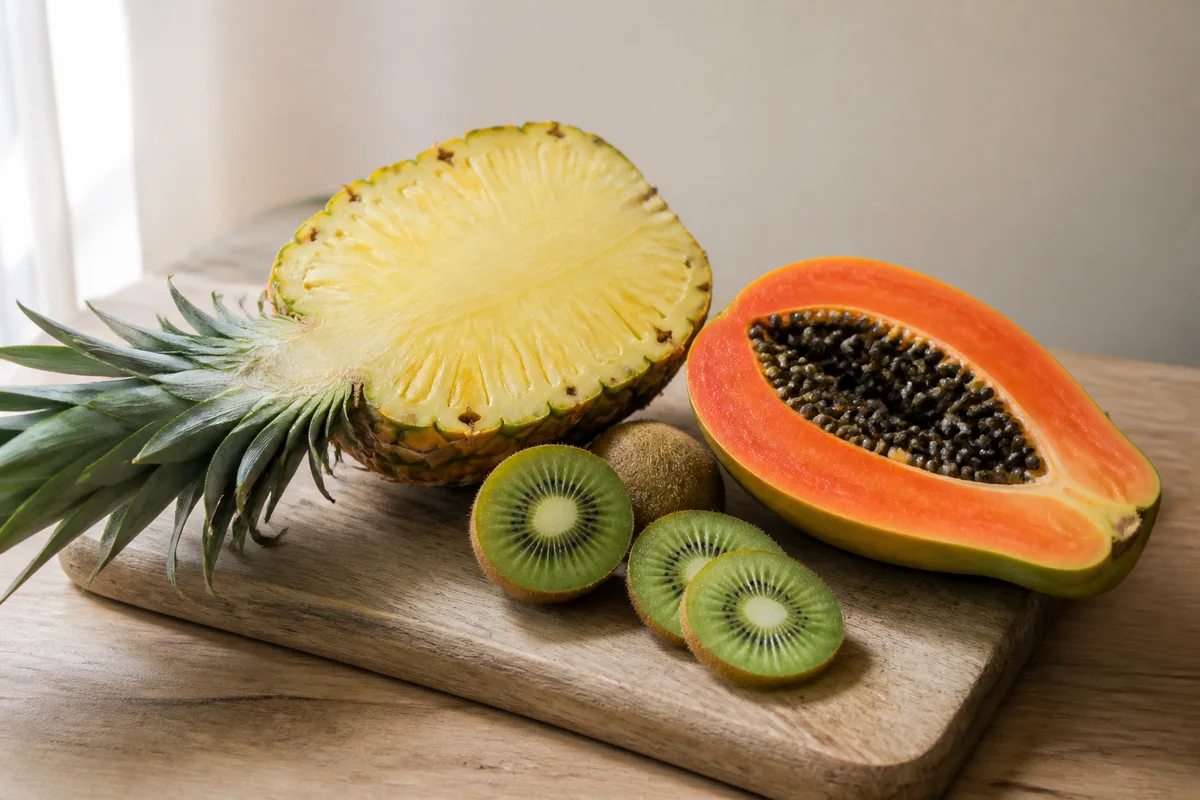
Pineapple, papaya, kiwi, mango, raw honey, avocado and unpasteurised fermented foods all contain active enzymes. Heat destroys them: most food enzymes are inactivated between 117 and 140°F, well below boiling, so a cooked diet contributes very little enzyme activity of its own.
Several foods carry active enzymes, and a handful carry quite a lot. If you would rather get things from a plate than a bottle, that is a reasonable instinct and worth taking seriously.
It is also worth being straight about the limits, because this is a corner of nutrition where the marketing has run well ahead of the evidence. So: the foods first, then an honest accounting of what they can and cannot do.
Foods that carry meaningful enzyme activity
Pineapple: bromelain
Bromelain is a protease, and pineapple is the best-known food source of one. It is concentrated in the core and the stem rather than the sweet flesh, which is the part most people discard.
Bromelain is active enough to be noticeable outside the body: it is why fresh pineapple can make your tongue tingle, the enzyme is acting on proteins at the surface of your mouth. It is also why fresh pineapple prevents gelatin from setting, and why it works as a meat tenderizer. Canned pineapple does none of this. Heat during canning inactivates the bromelain entirely, which is a useful everyday demonstration of how fragile these things are.
Papaya: papain
Papain is another protease, most concentrated in unripe green papaya and in the skin rather than the ripe flesh. Like bromelain, it is used commercially as a meat tenderizer. Also like bromelain, cooking destroys it.
Mango, kiwi, and banana
Kiwi contains actinidin, a protease, the reason kiwi also interferes with gelatin. Mango carries amylases that become more active as the fruit ripens, which is part of why ripe mango tastes sweeter: starch is being converted to sugar. Bananas work the same way, with amylase activity increasing through ripening.
Raw honey: several
Unheated honey contains amylase (as diastase), invertase, glucose oxidase, and catalase. Diastase activity is used commercially as a freshness and processing indicator, heavily heated or heavily processed honey shows low diastase, so the measurement tells you how the honey was treated as much as anything.
Most supermarket honey is pasteurized and filtered, which reduces this considerably. "Raw" on the label is the thing to look for.
Fermented foods: sauerkraut, kimchi, miso, kefir, yogurt
Fermented foods are a slightly different case. The enzymes come from the microbes that did the fermenting, and those microbes are often still present and still producing.
Yogurt is the clearest practical example: its live cultures carry lactase, which is why yogurt is frequently easier to handle than an equivalent amount of milk even though its lactose content is not dramatically lower. The bacteria bring their own lactase along.
Note that this only applies to unpasteurized ferments. Shelf-stable sauerkraut in a can has been heated. Miso stirred into boiling soup has been heated. The live-culture versions are refrigerated for a reason.
Avocado, raw sprouts, and raw dairy
Avocado contains lipase, one of the few reasonable food sources of a fat-digesting enzyme. Sprouted seeds and grains ramp up enzyme activity sharply during germination, that is what sprouting is, metabolically. Raw milk contains lipase and other enzymes; pasteurization inactivates them, which is one of the things pasteurization is designed to do.
What heat does
The rule of thumb: most food enzymes are inactivated somewhere in the 117–140°F range. That is well below boiling, and well below any real cooking temperature.
Practically, that means steaming, boiling, roasting, frying, canning, and pasteurizing all leave food with little to no enzymatic activity. Freezing is gentler and preserves more, though not indefinitely.
Since nearly everyone eats a mostly cooked diet, for good food-safety reasons, the enzyme contribution from food is modest for most people most of the time.
The honest part: how much do food enzymes actually help digestion?
Here is where we part company with a lot of what is written on this subject.
The intuitive story goes: raw foods contain enzymes, those enzymes help digest your meal, cooking destroys them, therefore cooked diets strain your body's own enzyme production. It is a tidy story. It is also weakly supported.
Enzymes are proteins, and your stomach digests proteins. That is precisely what stomach acid and pepsin are for. Many food enzymes are denatured and broken down in the stomach before they ever reach the small intestine, where most digestion happens. Your body does not distinguish between an enzyme from a pineapple and any other dietary protein.
Some hold up better than others, enzymes with more acid-stable structures survive further, and a few have been studied for activity beyond the stomach. But the blanket claim that eating raw food meaningfully supplies working digestive enzymes to your intestine is not well established.
Two things follow, and they point in opposite directions:
The first is that the "enzyme-rich raw diet" argument is oversold. Raw fruits and vegetables are genuinely worth eating, for fiber, vitamins, water content, and heat-sensitive nutrients like vitamin C. Their enzyme content is a secondary reason at best.
The second is that this is exactly why supplemental enzymes are formulated differently from food. A well-made enzyme supplement is not simply a concentrated version of pineapple. The enzymes are selected for activity across the pH ranges they will actually encounter, and encapsulated to reach the point in digestion where they do their work. Acid-stable proteases and fungal-sourced enzymes are chosen partly because they hold up where food enzymes do not.
We would rather say that plainly than sell you the raw-food story.
A reasonable position
If you want to support digestion through food, the honest recommendation is not "eat raw for the enzymes." It is more ordinary than that: eat some raw produce regularly, include live-culture fermented foods if you like them, chew properly, which genuinely does matter, since salivary amylase gets a real head start on starch and mechanical breakdown increases the surface area everything else works on, and do not eat your largest, richest meal in a rush.
Supplemental enzymes are worth considering for the narrower cases: specific foods that reliably sit badly, meals substantially heavier than your normal, or wanting broad coverage at the meal itself. They are not a replacement for any of the above, and a consistent painful reaction to a particular food is worth raising with a doctor rather than managing indefinitely.
Where a plant-sourced supplement fits
Healthy Tract Digestive Enzymes is plant-sourced rather than animal-derived, vegetarian, vegan-friendly, and kosher-certified, which matters to people who came to this question from the food direction in the first place.
It carries eleven enzymes in a single capsule, covering starches and sugars, protein across three pH ranges, fat, dairy, and the bean and cruciferous-vegetable carbohydrates human enzymes cannot cut. It is formulated without any of the nine major food allergens.
For which enzyme handles which food, see which digestive enzyme breaks down what. For the underlying mechanics, start with what digestive enzymes actually do.
These statements have not been evaluated by the Food and Drug Administration. This product is not intended to diagnose, treat, cure, or prevent any disease.