
Saw Palmetto: Oil Extract vs. Powder, and Why the Label Rarely Tells You
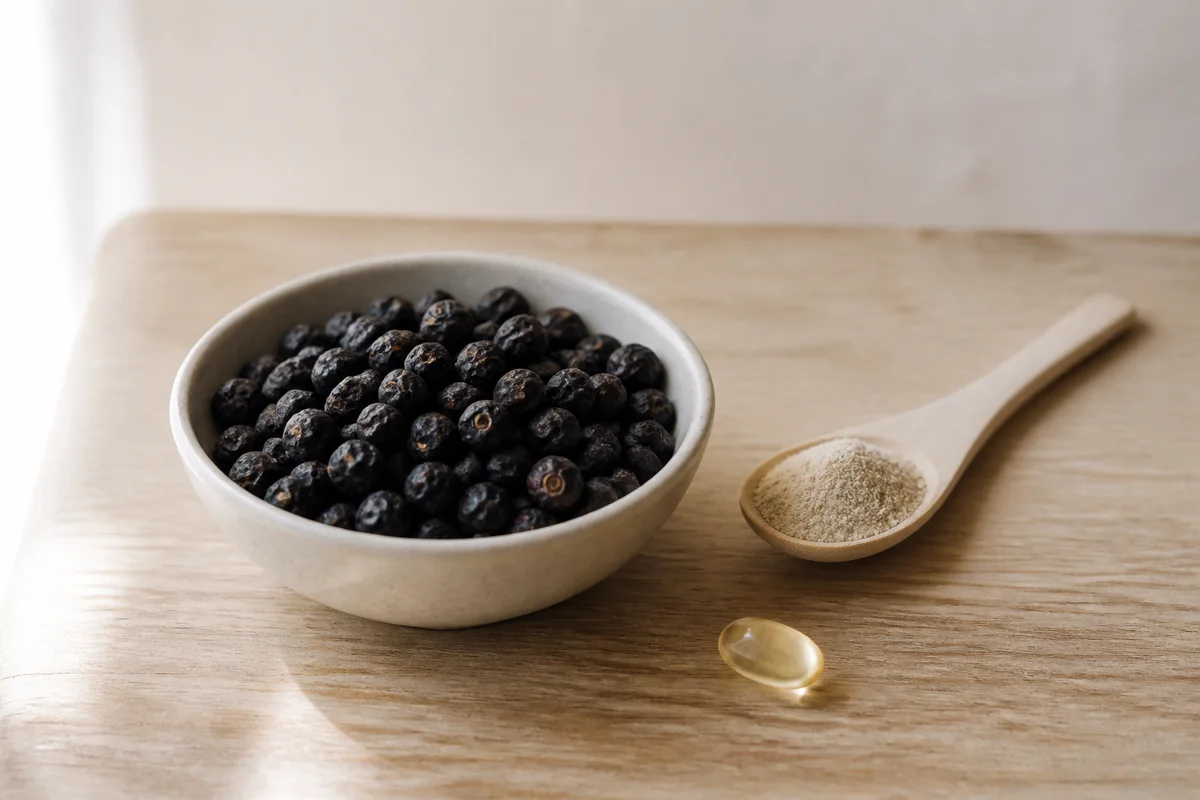
Saw palmetto's active compounds, free fatty acids and phytosterols, are in the oil of the berry, not the fibre. A lipidosterolic oil extract standardised to 85% free fatty acids and sterols therefore carries many times the actives of an equal weight of dried berry powder, even though both may be labelled simply 'saw palmetto'.
Saw palmetto is the most studied botanical in the prostate category. It is also the one where two products can carry an identical line on the label and contain almost nothing in common.
The reason is simple enough to explain in a paragraph, and it is the single most useful thing to understand before buying any of them.
Before that, the same note that belongs on anything in this category: urinary changes in older men, a weak stream, trouble starting, frequent night waking, pain, or blood, are a reason to see a doctor. Several different conditions produce similar symptoms. Sorting out which one you have is a medical question, not a shopping one.
The active compounds are in the oil, not the fibre
Serenoa repens is a small palm native to the southeastern United States. Its dark berries have a long history of traditional use.
The compounds researchers have concentrated on are free fatty acids, lauric, oleic, myristic, and others, along with phytosterols such as beta-sitosterol. These are fat-soluble, and they live in the lipid fraction of the berry: the oil.
The rest of the berry is largely fibre, water, and carbohydrate. Useful for the plant. Not what the research was about.
That single fact splits the category in two.
Powder versus extract
Dried berry powder is the whole berry, milled. It is inexpensive to make, dry it, grind it, put it in a capsule. It contains whatever proportion of oil the berry naturally had, which is a small share of total weight, and that proportion varies with growing conditions, ripeness, and season.
A lipidosterolic extract uses a solvent, usually supercritical CO₂ or hexane, to pull the oil fraction out and leave the fibre behind. The result is concentrated in exactly the compounds of interest, and it can be standardized: manufactured to hit a specified percentage every batch, commonly 85% or more combined free fatty acids and sterols.
Here is the practical consequence. A capsule of powder might be a few percent fatty acids by weight. An 85%-standardized oil extract is, by definition, 85%. So 300 mg of a standardized oil extract can carry many times the actives of 600 mg of powder, and the label line "saw palmetto 600 mg" looks bigger.
Milligrams of material and milligrams of actives are different numbers, and only one of them is printed.
Why standardization is the part that matters
Botanicals are agricultural products. Two harvests of the same species from the same field differ.
Standardization is the manufacturing step that removes that variability: every batch is assayed and adjusted to hit the same specification. Without it, "saw palmetto extract" describes a process, not a content, and there is no assurance that this bottle resembles the last one, let alone the material used in any published study.
When you see "standardized to 85% free fatty acids and sterols," that is a manufacturing commitment you can hold the maker to. When you see "saw palmetto extract 4:1" or just "saw palmetto," you have been told the ratio or the plant and nothing about the content.
How to read the label in ten seconds
- "Saw palmetto berry powder" or just "saw palmetto berry", whole berry. Cheapest form, lowest and most variable actives.
- "Saw palmetto extract" with no standardization figure, an extract of unstated concentration. Better than powder, still unverifiable.
- "Saw palmetto oil extract, standardized to 85% free fatty acids and sterols", the form the research literature is built on, at a content you can check.
- A named extract (a registered ingredient name rather than a generic description), traceable to a specific manufacturer and their published work.
One more: softgel versus capsule is a reasonable secondary hint. An oil extract is a liquid at room temperature and is normally delivered in a softgel. A hard capsule of dry powder is usually exactly what it looks like.
What it does not do
Worth being direct, because the marketing in this category often is not.
Saw palmetto is a structure-function supplement: it is taken to support normal prostate function and normal urinary flow. It is not a treatment for any disease, and no supplement may be sold as one. Clinical research on saw palmetto has produced genuinely mixed results, some trials positive, some null, with the form and standardization of the extract varying enormously between them, which is part of why the picture is muddy.
Anyone promising it will shrink, cure, or fix something has left what the evidence supports, and told you something about themselves.
What we use, and why
Prostate Health Tabs is built on USPlus® saw palmetto, a lipidosterolic oil extract standardized to 85% free fatty acids and sterols, and the first and only USP-verified extract of its kind. Each softgel carries 320 mg, roughly double what many formulas provide, with no other botanicals on the panel.
That is the whole ingredient list, which is the point: one named, traceable, standardized, third-party-verified extract at a disclosed dose, taken as one softgel a day to help maintain healthy prostate function and support normal urinary flow and more restful nights.
If you are comparing formulas more broadly, what to look for in a prostate supplement walks through the rest of the panel, proprietary blends, verification marks, and the questions worth asking before you spend anything.
These statements have not been evaluated by the Food and Drug Administration. This product is not intended to diagnose, treat, cure, or prevent any disease.