
What to Look for in a Prostate Supplement: Reading the Panel Before You Buy
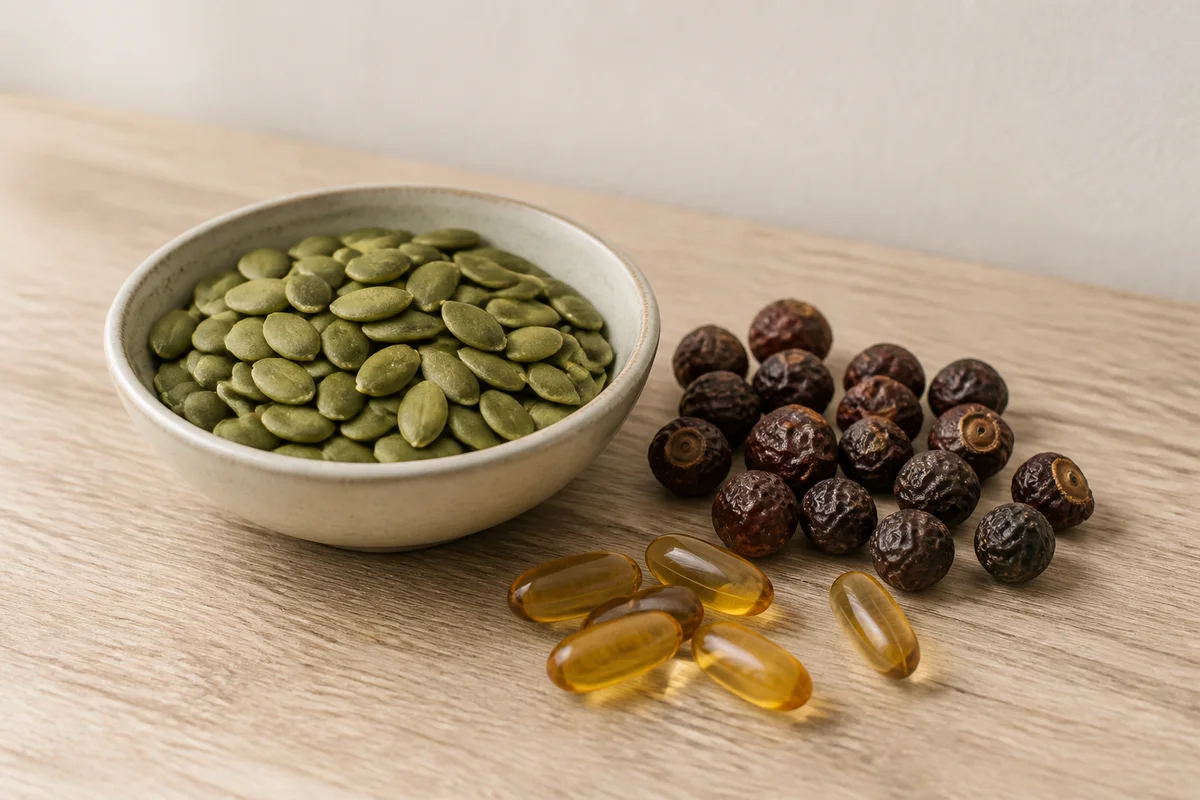
The two things that separate prostate supplements are whether each ingredient carries its own disclosed dose, and if it contains saw palmetto, whether that saw palmetto is an oil extract rather than a dried berry powder. Urinary symptoms in older men should be assessed by a doctor first, because several different conditions present the same way.
Walk down the prostate aisle and the labels blur together: fifteen ingredients, impressive-sounding names, a proprietary blend, and no way to tell any of them apart.
Here is how to actually read one.
First, though, the part that matters more than any label. Urinary changes in older men are a reason to see a doctor, not a reason to shop. Difficulty starting, a weak stream, getting up repeatedly at night, blood in the urine, or pain, those are worth a conversation with a physician, because several different conditions produce similar symptoms and some of them need real treatment. A supplement is not a substitute for knowing which one you have. Everything below assumes you have done that, and are looking for everyday support alongside it.
The single biggest tell: how many ingredients, and at what dose
The most common design in this category is the kitchen-sink formula. Saw palmetto, pygeum, nettle root, pumpkin seed, lycopene, beta-sitosterol, zinc, selenium, and a half-dozen more, all inside one proprietary blend with a single combined weight.
The problem is arithmetic. If the blend is 500 mg total and there are twelve ingredients, the average is about 40 mg each, and the actual split is not disclosed, so it can be 400 mg of the cheapest one and a dusting of the rest. Most of those botanicals have been studied at doses several times higher than what a crowded blend can deliver.
More names on the label is not more support. It is usually less of everything, arranged to look like more.
What to look for instead: ingredients listed individually with their own milligram amounts. If you cannot see the dose, you cannot evaluate the product, and that is generally the point of hiding it.
Saw palmetto: the form matters more than the milligrams
Saw palmetto is the most-studied ingredient in the category, and also the one where the label hides the most.
The compounds researchers care about, free fatty acids and sterols, live in the oil of the berry. They are not meaningfully present in dried, milled berry powder. Yet "saw palmetto 500 mg" on a label can mean either one.
So the question is not how many milligrams. It is:
- Is it an oil extract or a powder? A lipidosterolic (oil) extract is the form that carries the actives. Powder is cheaper and mostly fibre.
- Is it standardized, and to what? The meaningful standardization is to free fatty acids and sterols, commonly 85%. No standardization figure means the content varies batch to batch.
- Is the extract named? A named, traceable extract can be matched to the published work on that specific material. "Saw palmetto extract" cannot.
A smaller dose of a standardized oil extract is a more serious product than a larger dose of unstandardized powder. This is the single place where reading carefully changes what you end up with.
Verification: who checked, and what did they check
Supplements are not pre-approved by the FDA, so third-party verification is the only outside check on what is in the bottle.
USP verification is the strictest commonly available. It confirms identity, potency, and purity, and that the product was made under good manufacturing practices. It is uncommon in this category, most prostate products carry no third-party mark at all.
Weaker signals that are often dressed up to look equivalent: "made in a GMP-certified facility" describes the building, not the product. "Lab tested" with no named lab or standard means nothing you can check.
Zinc, lycopene, and the supporting cast
Several other ingredients turn up routinely. Worth knowing what they are for, and what they are not.
Zinc is concentrated in prostate tissue and is an essential mineral, so adequacy matters. But more is not better: high-dose zinc over time interferes with copper absorption, and there is no case for megadosing it.
Lycopene, selenium, and beta-sitosterol all appear frequently. Each has a research literature of varying quality. None of them rescues a formula whose doses are hidden.
Pygeum and nettle root are traditional additions, usually present in crowded blends at token amounts.
If you already take a multivitamin, check for overlap before stacking, zinc and selenium in particular are easy to double up on without noticing.
Five questions before you buy
- Can I see a dose next to every active ingredient, or is it a blend?
- If it contains saw palmetto, oil extract or powder, and standardized to what?
- Is there third-party verification, and by whom?
- What is the cost per day, at the serving size actually on the label?
- Does the marketing promise to treat a condition? If so, be more skeptical, not less, that is a claim no supplement is permitted to make.
Where Prostate Health Tabs sits
Prostate Health Tabs is deliberately the opposite of the kitchen-sink approach: one named ingredient, disclosed in full.
Each softgel carries 320 mg of USPlus® saw palmetto oil extract, a lipidosterolic extract standardized to 85% free fatty acids and sterols, and the first and only USP-verified saw palmetto of its kind. Roughly double the amount in many formulas, with no filler botanicals padding the panel.
It is taken as one softgel a day, to help maintain healthy prostate function and support normal urinary flow and more restful nights.
We would rather do one thing properly than list twelve things we cannot dose correctly, and the reason we can tell you exactly what is in it is the same reason we would ask you to check that on anything else you are considering.
If the form question is the part you want to go deeper on, saw palmetto oil extract versus powder covers why the two are not interchangeable.
These statements have not been evaluated by the Food and Drug Administration. This product is not intended to diagnose, treat, cure, or prevent any disease.