
Ubiquinol vs. Ubiquinone: Which Form of CoQ10 Is on Your Label
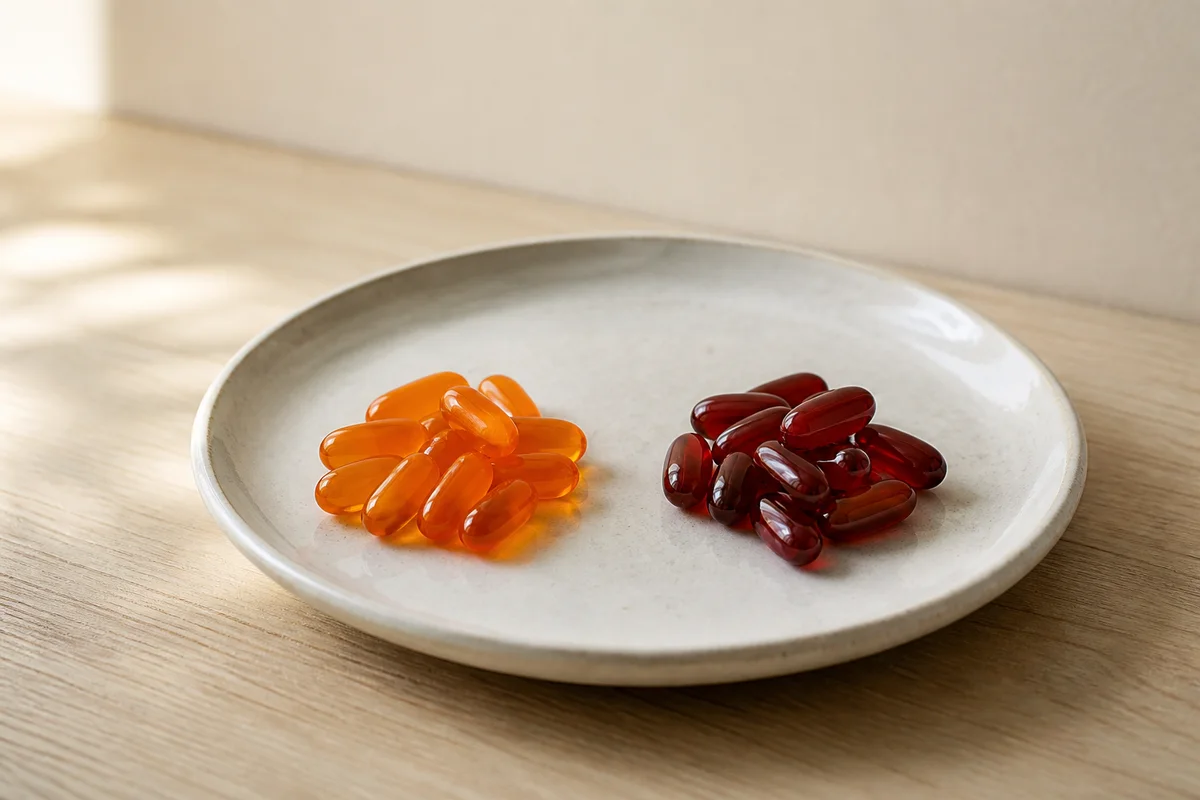
Ubiquinone and ubiquinol are the two states of the same molecule, coenzyme Q10. Ubiquinone is the oxidised form and is what most CoQ10 products contain; ubiquinol is the reduced form, which is the state in which it acts as an antioxidant. A healthy body converts between them continuously, so the form matters less than absorption. CoQ10 is fat-soluble and should be taken with a meal containing fat.
CoQ10 is one of the few supplements where the form on the label changes what you are buying more than the milligrams do, and most bottles do not make the distinction obvious.
One compound, two states
Coenzyme Q10 is a fat-soluble compound found in essentially every cell, sitting in the mitochondrial membrane where it shuttles electrons through the chain that produces cellular energy. It also acts as an antioxidant in lipid membranes.
Its whole function depends on being able to flip between two states:
- Ubiquinone: the oxidised form. It has accepted electrons and passed them on.
- Ubiquinol: the reduced form. It is carrying two extra electrons, which is the state in which it acts as an antioxidant.
Your body converts continuously between the two; that cycling is the job. In healthy adults, most of the CoQ10 circulating in blood is in the ubiquinol form.
Why the label form matters
Ubiquinone is what the great majority of CoQ10 products contain. It is crystalline, chemically stable, cheap to manufacture by fermentation, and it has the longer research history, most of the older clinical literature used it.
Ubiquinol is the reduced form, sold directly. It is less stable, it oxidises on contact with air, so it needs protective formulation and a softgel rather than a tablet, and it is significantly more expensive.
The argument for ubiquinol is that it skips a conversion step. Swallowed ubiquinone has to be reduced to ubiquinol before it does antioxidant work. Absorption studies generally find ubiquinol produces higher plasma CoQ10 levels per milligram than ubiquinone.
Two caveats, stated plainly. The size of that advantage varies a lot between studies and several were funded by ubiquinol manufacturers. And a healthy body converts ubiquinone to ubiquinol perfectly well, the conversion is not a bottleneck for most people. The argument for ubiquinol is strongest for older adults, where conversion efficiency is thought to decline, and weakest for someone young and healthy who would do fine on either.
That is a narrower case than the category usually makes, and it is the accurate one.
The thing that matters more than either
CoQ10 in any form is fat-soluble and poorly absorbed. Absorption is the real constraint, not the oxidation state.
Practical consequences:
Take it with a meal containing fat. This makes a larger difference than ubiquinol-versus-ubiquinone. On an empty stomach, absorption of either is poor.
Softgels in oil beat dry powder in a hard capsule. A dry crystalline ubiquinone powder is the least absorbable presentation on the shelf, and it is common because it is cheap.
Split larger doses. Absorption is saturable; two smaller doses generally beat one large one.
Someone taking a well-formulated ubiquinone softgel with dinner is very likely ahead of someone taking dry-powder ubiquinol on an empty stomach, whatever the front of the bottle says.
Statins, and why we are not going to make a claim about them
You will see CoQ10 marketed to people on statins, on the basis that statins inhibit the same biochemical pathway the body uses to make CoQ10, and that blood CoQ10 levels do measurably fall on statin therapy.
The first part is accurate biochemistry. What has not been established is that supplementing CoQ10 resolves statin-associated muscle symptoms, trials have been mixed and the better-controlled ones have largely been negative.
More importantly: if you are on a statin and having muscle pain, that is a conversation with the prescriber, not something to self-manage with a supplement. Do not stop or alter a statin, and do not add anything, without telling the doctor who prescribed it.
We are not going to tell you CoQ10 fixes that, because nobody has shown it does.
Reading the label
- Ubiquinol or ubiquinone, stated explicitly? "CoQ10 100 mg" alone is almost always ubiquinone.
- Softgel with an oil carrier, or dry powder? This affects absorption more than the form does.
- A named raw material? Ubiquinol in particular is difficult to stabilise, and a named ingredient ties the product to a specific manufacturer's process.
- Opaque packaging. Ubiquinol oxidises with light and air exposure.
What we make
Active CoQ10 Ubiquinol is 100 mg of Kaneka Ubiquinol™ in a single daily softgel, the reduced, already-body-ready form, in an oil-based softgel rather than a dry capsule, from the manufacturer that first produced stabilised ubiquinol at scale.
It is intended for everyday cellular energy and antioxidant support. Take it with a meal that contains some fat, as above, that will do more for you than the choice of form.
For the other side of cellular energy, what NAD⁺ actually is covers the coenzyme that works alongside it in the same pathway, and is just as over-claimed.
These statements have not been evaluated by the Food and Drug Administration. This product is not intended to diagnose, treat, cure, or prevent any disease.