
Do Men Need Iron Supplements? Usually Not: and Here Is Why That Matters
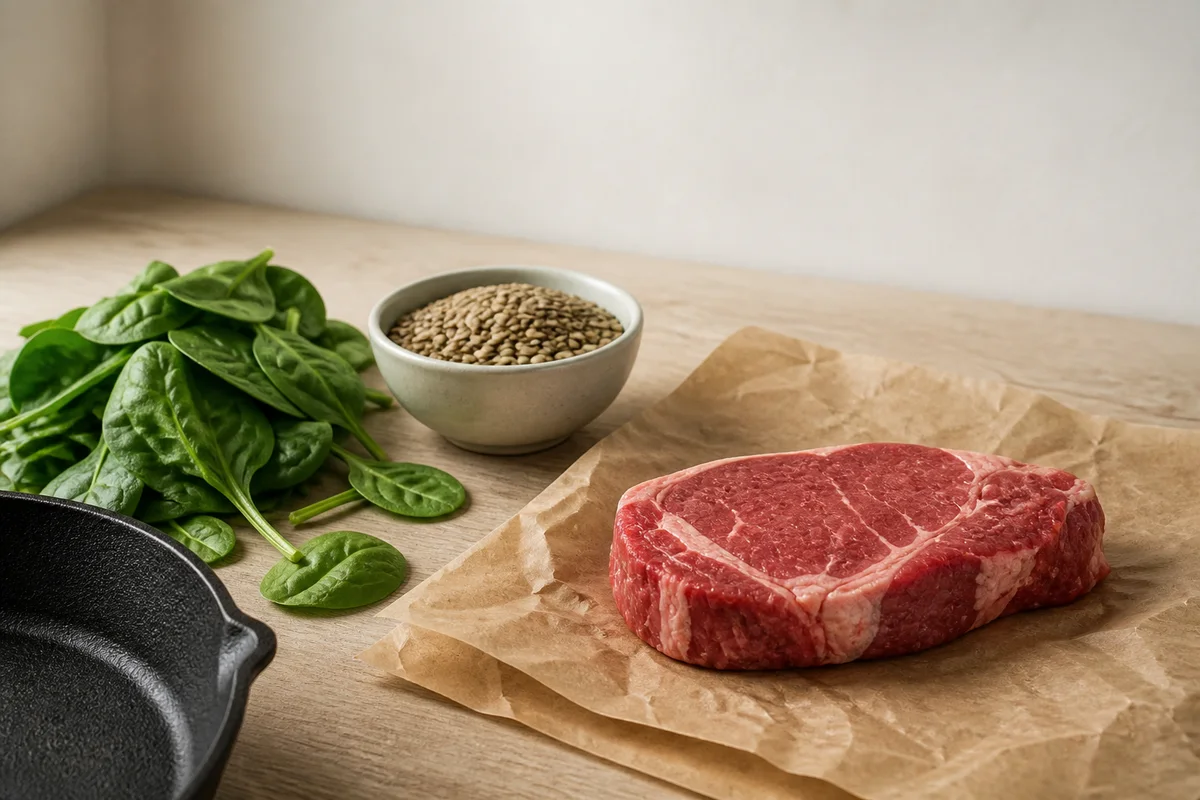
Most adult men do not need an iron supplement. The RDA for men is 8 mg a day against 18 mg for women aged 19 to 50, because men have no routine route of iron loss and no active means of excreting a surplus. Iron deficiency in an adult man usually indicates blood loss somewhere and should be investigated by a doctor rather than corrected with a supplement.
Iron is the one nutrient where the standard advice genuinely flips depending on who you are. For a lot of women it is the mineral most worth paying attention to. For most adult men it is the one to leave alone unless a blood test says otherwise.
That is an unusual thing for a supplement company to write, so here is the reasoning.
The requirement is not close
The RDA for adult men is 8 mg a day. For women aged 19–50 it is 18 mg, more than double. After menopause a woman's requirement drops to the same 8 mg as a man's.
The reason is straightforward: menstruation is a regular, meaningful route of iron loss. Men have no equivalent. Outside of bleeding, the body has no active mechanism for excreting iron, small amounts are shed through skin cells and gut lining and that is essentially it.
So the picture for a typical adult man is a modest requirement, a normal diet that usually meets it, and no way to get rid of a surplus.
Why that last part matters
Because iron accumulates.
Absorption is regulated at the gut, the body takes up less when stores are adequate, but that regulation is partial, and it is not a guarantee against long-term buildup from high-dose supplementation.
There is also a common genetic condition worth knowing about. Hereditary hemochromatosis causes the gut to absorb more iron than it should, leading to accumulation in the liver, heart and pancreas over decades. It is one of the more common genetic conditions in people of northern European descent, and many carriers do not know until damage has begun. It typically presents later in men than women, for the same reason the requirement differs, women lose iron monthly for much of adult life.
Nobody is suggesting a multivitamin causes hemochromatosis. The point is narrower and worth taking seriously: a man taking a high-dose standalone iron supplement without a diagnosed deficiency has no upside and a real, if small, downside.
Why "I feel tired" is not a reason to take iron
This is where most unnecessary iron supplementation starts.
Fatigue is the symptom people most associate with low iron, and it is a real symptom of it. But fatigue is also the least specific complaint in medicine. Low B-12, thyroid problems, poor sleep, depression, sleep apnoea and a dozen other things present the same way, and in a man, iron deficiency is uncommon enough that it is not the first thing to reach for.
More importantly, iron deficiency in an adult man is a finding that needs explaining, not just correcting. Because men do not have a routine route of loss, deficiency implies blood is being lost somewhere, commonly the gastrointestinal tract. That can be something minor. It can also be the first sign of something that needs looking at promptly.
Taking an iron supplement to fix the number can mask the symptom while leaving the cause unexamined. That is the actual risk, and it is a bigger one than the iron itself.
If you think you might be low, get a blood test. Ferritin and transferrin saturation are the usual measures, they are cheap and routine, and the result tells you something a supplement guess cannot.
Where men's iron does come from
For most men, food covers it without effort.
Heme iron: from meat, poultry and fish, is absorbed considerably more efficiently than the non-heme iron in plants. Non-heme iron comes from legumes, tofu, fortified grains, nuts and dark leafy greens, and its absorption depends heavily on what it is eaten with: vitamin C improves it noticeably, and the tannins in tea and coffee, plus calcium taken at the same time, reduce it.
Men who eat little or no meat, endurance athletes, and regular blood donors have genuinely higher needs than average, but those are still cases for a blood test, not for assuming.
What this means for a multivitamin
There is a real difference between a multivitamin containing iron at or near the RDA and a standalone iron supplement, which commonly delivers 45–65 mg of elemental iron, five to eight times a man's daily requirement.
The first is a reasonable nutritional baseline. The second is a therapeutic dose that should follow a diagnosis.
This is also why men's and women's formulas are not simply the same tablet in different packaging. A formula calibrated for women has to account for a requirement more than double a man's during the years it applies. A formula built for men does not, and the space is better spent elsewhere.
How Fitness Tabs handles it
Fitness Tabs for Men and Fitness Tabs for Women are separate formulas rather than one tablet with different labelling, and iron is one of the reasons.
The men's formula carries iron alongside magnesium and the trace minerals that round out a daily foundation. The women's formula adjusts iron upward and places it in the morning tablet with B-6, deliberately away from the calcium and vitamin D-3 in the afternoon tablet, because calcium and iron compete for absorption when taken together.
That separation is only possible because the formula is split across two tablets a day, which is a design decision we go into properly in should you take a multivitamin twice a day.
Neither is a therapeutic iron supplement, and neither is intended to correct a diagnosed deficiency. If a blood test says you are low, that is a conversation with your doctor about a dose a multivitamin is not designed to deliver.
These statements have not been evaluated by the Food and Drug Administration. This product is not intended to diagnose, treat, cure, or prevent any disease.