
Magnesium Glycinate vs. Other Forms: Which One, and How Much?
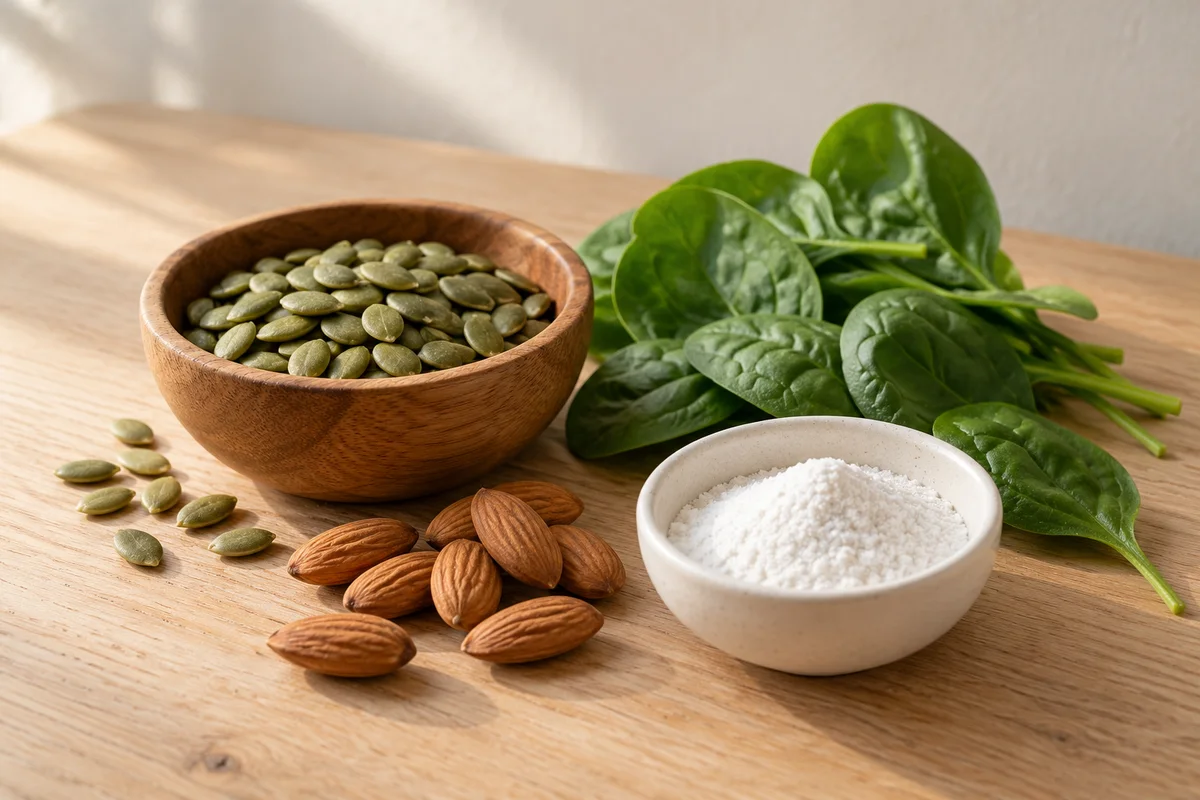
Magnesium glycinate (also called bisglycinate) is magnesium bound to the amino acid glycine. It is often chosen because it is considered gentle on the stomach, and in one small study it was better tolerated than magnesium oxide; the evidence that it is absorbed better than other soluble forms such as citrate is thin. For adults, magnesium from supplements should stay at or below 350 mg a day unless a doctor advises more, and magnesium should be taken a few hours apart from certain antibiotics and osteoporosis medicines.
Supplement shelves offer magnesium as oxide, citrate, glycinate, malate, threonate and more, often with confident claims attached. Here is what the research shows.
Why magnesium matters, and why older adults fall short
Magnesium is a cofactor in more than 300 enzyme systems, including those involved in protein synthesis, muscle and nerve function, and energy production (NIH Office of Dietary Supplements).
The recommended daily amount for adults over 50 is 420 mg for men and 320 mg for women, from all sources. Many people don't reach it. National survey data from 2013 to 2016 (NHANES) found that 48 percent of Americans get less magnesium from food and drink than the estimated average requirement, and men 71 and older were among the most likely to come up short. Older adults also absorb less magnesium from the gut and lose more in urine, and are more likely to take medicines that affect magnesium levels (NIH Office of Dietary Supplements). Low intake is not the same as deficiency: the same source notes that symptoms of magnesium deficiency are uncommon in healthy people, because the kidneys hold on to magnesium when intake is low.
Food comes first. Green leafy vegetables, beans, nuts, seeds and whole grains are good sources. An ounce of dry-roasted almonds has about 80 mg and half a cup of boiled spinach about 78 mg (NIH Office of Dietary Supplements). A supplement is a top-up for the gap.
Does the form matter?
Somewhat.
The NIH summary is that forms which dissolve well in liquid are absorbed more completely, and that small studies have found magnesium aspartate, citrate, lactate and chloride more bioavailable than magnesium oxide and sulfate (NIH Office of Dietary Supplements). Oxide is common in tablets, and one study measured its fractional absorption at about 4 percent, against significantly higher and roughly equal absorption for chloride, lactate and aspartate (Firoz and Graber, 2001).
Glycinate has little direct human data on absorption. One study compared it with oxide in 12 patients who had part of their small intestine removed, a group that struggles to absorb magnesium. Overall absorption was about the same for both forms (23.5 percent versus 22.8 percent). In the four patients with the poorest absorption, glycinate did roughly twice as well, and it was better tolerated by all of the patients (Schuette and colleagues, 1994). A 2024 single-dose study in 40 healthy adults, funded by the maker of a competing microencapsulated magnesium ingredient, saw no significant rise in blood magnesium over six hours after bisglycinate (Pajuelo and colleagues, 2024). These studies used different methods (urine, isotope tracers, blood levels), so their percentages can't be compared directly, and single-dose blood levels are a rough measure.
Our summary: glycinate is a reasonable choice, and tolerance matters, because diarrhea is a common side effect of higher-dose magnesium supplements. Claims that glycinate is dramatically better absorbed than every other form go beyond the published evidence.
On sleep, there is now one decent trial. In 2025, 155 adults aged 18 to 65 who reported poor sleep took 250 mg of magnesium from bisglycinate or a placebo. After four weeks, the magnesium group's insomnia scores improved slightly more than placebo's. The authors called the effect small, and it was measured by questionnaire rather than sleep testing (Schuster and colleagues, 2025). A modest signal from one study, at more than twice the amount in a typical top-up.
Read the label for elemental magnesium
A Supplement Facts panel lists the amount of elemental magnesium, the magnesium itself, not the weight of the whole compound (NIH Office of Dietary Supplements). Glycinate is a bulky compound, so it takes several hundred milligrams of magnesium bisglycinate to supply 100 mg of magnesium. When you compare products, compare the elemental number.
How much is a sensible top-up?
The Tolerable Upper Intake Level for adults is 350 mg a day from supplements and medicines. That limit does not include magnesium from food, which does not pose a health risk in healthy people because the kidneys clear the excess (NIH Office of Dietary Supplements). High doses from supplements can cause diarrhea, nausea and cramping.
A few practical points:
- Add up every source. A multivitamin, a separate magnesium tablet, a powder and an antacid or laxative can each contain magnesium. The 350 mg limit is for all of them together.
- Kidney disease changes the picture. The risk of too much magnesium rises when the kidneys can't clear it, so anyone with reduced kidney function should ask their doctor before taking magnesium (NIH Office of Dietary Supplements).
- Smaller amounts are often enough. If your diet falls short, a 100 mg top-up closes part of the gap and stays well under the limit.
Medications that need space
Magnesium can bind to some medicines in the gut. From the NIH guidance (NIH Office of Dietary Supplements):
- Osteoporosis tablets (oral bisphosphonates such as alendronate): take magnesium at least 2 hours before or after.
- Tetracycline and quinolone antibiotics (such as doxycycline or ciprofloxacin): take the antibiotic at least 2 hours before, or 4 to 6 hours after, a magnesium supplement.
- Diuretics and long-term acid reducers (proton pump inhibitors): these can change magnesium levels in the body. Some diuretics increase the magnesium lost in urine and others reduce it. Spacing doses does not change that, so your doctor should know you take magnesium.
If you take any prescription medicine every day, mention your magnesium to your doctor or pharmacist.
What we don't know yet
- Glycinate head to head. We found no good trial comparing glycinate with citrate over weeks in healthy older adults.
- Which outcome to measure. Blood magnesium correlates poorly with the body's total stores, most of which sit in bone and inside cells (NIH Office of Dietary Supplements), so absorption studies are hard to interpret.
- Form-specific benefits. Apart from the one sleep trial above, claims tied to a particular form, for sleep, mood or the brain, rest on little human evidence that we could find.
Common questions
Is magnesium glycinate the same as bisglycinate?
Yes, in practice. Bisglycinate and diglycinate both describe magnesium bound to two glycine molecules. Labels use the names interchangeably.
Can I take magnesium with my multivitamin?
Usually, yes. Add the magnesium in both, plus any antacids or laxatives that contain it, and keep the total from supplements and medicines at or below 350 mg a day, unless your doctor advises otherwise.
Should I take magnesium in the morning or at night?
We found no good evidence that timing matters for a top-up dose. Choose a time you'll remember, and keep it apart from the medicines listed above.
Where PowerFactors fits
MDR PowerFactors includes 100 mg of magnesium from magnesium bisglycinate per scoop, 24 percent of the Daily Value, along with 5 grams of creatine monohydrate, 250 mg of NMN and 100 mg of collagen peptides. We chose bisglycinate because it is generally well tolerated, and 100 mg because it is a top-up, leaving up to 250 mg for any other supplements or medicines that contain magnesium. It is not a replacement for magnesium-rich food. If you take a separate magnesium supplement already, count it. More on the full formula in Creatine and NMN together.
Last updated October 19, 2026.
Sources
- NIH Office of Dietary Supplements. Magnesium: Fact Sheet for Health Professionals (updated January 6, 2026). ods.od.nih.gov
- Firoz M, Graber M. Bioavailability of US commercial magnesium preparations. Magnes Res. 2001;14(4):257-262. PubMed 11794633
- Schuette SA, Lashner BA, Janghorbani M. Bioavailability of magnesium diglycinate vs magnesium oxide in patients with ileal resection. JPEN J Parenter Enteral Nutr. 1994;18(5):430-435. PubMed 7815675
- Schuster J, et al. Magnesium bisglycinate supplementation in healthy adults reporting poor sleep: a randomized, placebo-controlled trial. Nat Sci Sleep. 2025. PubMed 40918053
- Pajuelo D, et al. Comparative clinical study on magnesium absorption and side effects after oral intake of microencapsulated magnesium (MAGSHAPE microcapsules) versus other magnesium sources. Nutrients. 2024;16(24):4367. PubMed 39770988
†These statements have not been evaluated by the Food and Drug Administration. This product is not intended to diagnose, treat, cure, or prevent any disease.