
Creatine and NMN Together: Is There a Reason to Combine Them?
We found no published trial that tests creatine and NMN together, so nobody can say the combination does more than either ingredient alone. The case for taking them in one scoop is convenience. Creatine has good evidence for strength and lean mass in older adults who strength-train; NMN raises NAD+ in the blood but has not shown clear physical benefits; magnesium is a nutrient many older adults get too little of from food. If strength training is your only goal, plain creatine monohydrate gives you the same creatine for less.
We make a product that combines these ingredients, MDR PowerFactors. Here is what the evidence supports, including who should not buy it.
What each ingredient brings, briefly
Creatine monohydrate. The most evidence of the three, for strength with training. Across 22 randomized trials in adults with average ages of 57 to 70, creatine taken alongside resistance training added about 1.4 kg (3 pounds) of lean tissue and more strength than training alone (Chilibeck and colleagues, 2017). The full picture is in Creatine after 50. There is also early, mixed research on creatine and the brain, covered in Creatine and the brain.
NMN. Raised blood NAD+ at 250 mg a day over 12 weeks (Okabe and colleagues, 2022), and has been generally well tolerated in trials of up to 24 weeks. A 2025 meta-analysis found no significant effect on muscle mass or strength in older adults (Prokopidis and colleagues, 2025), and a 2026 trial at five times that dose found no statistically significant improvement in physical performance (Igarashi and colleagues, 2026). Details in NMN: what the human studies show.
Magnesium. Needed by hundreds of enzymes, and 48 percent of Americans get less than the estimated average requirement from food, with men over 70 among the most likely to fall short (NIH Office of Dietary Supplements). See Magnesium glycinate vs. other forms.
Is there a biological reason to put them together?
On paper, yes. All three touch the way cells produce and use energy.
- Creatine, partly stored as phosphocreatine, helps muscle and brain cells recycle ATP quickly when demand rises (NIH Office of Dietary Supplements; Sandkühler and colleagues, 2023).
- NAD+, which the body makes from NMN (Okabe and colleagues, 2022), carries electrons in the reactions mitochondria use to turn food into ATP in the first place (Massudi and colleagues, 2012).
- Magnesium is required for energy production, including the main pathways that make ATP (NIH Office of Dietary Supplements).
That is a rationale, not evidence that the three work better together, and it is not evidence about the safety of the combination either. On October 19, 2026 we searched PubMed for creatine together with NMN, nicotinamide mononucleotide, nicotinamide riboside or "NAD precursor" and found no trial of the combination. That does not prove none exists anywhere, but we could not find one.
Who a combined product makes sense for
- You are over 50, you strength-train or plan to, and you want creatine. That is the ingredient with the best evidence, and PowerFactors has 5 grams of it, the amount used in many trials.
- You are also interested in NMN and understand the evidence for it is still mostly about blood NAD+ levels; results on outcomes you would notice are mixed and unproven.
- You like one scoop better than three bottles. That is a convenience preference, and a fair one.
Who should buy plain creatine instead
- If creatine for your training is all you want. Plain creatine monohydrate is the same ingredient that was used in the strength trials, and it typically costs much less per serving than a combined formula. PowerFactors is $59.95 for 25 servings (about $2.40 a serving), or $53.96 with Subscribe & Save.
- If you are not interested in NMN. Then you would be paying for an ingredient you don't want.
- If you already take a multivitamin, magnesium supplement, antacid or laxative that brings your supplemental magnesium near the 350 mg limit. Add up your sources first (NIH Office of Dietary Supplements).
Who should talk to a doctor first
- Anyone with kidney disease or reduced kidney function. Creatine can raise blood creatinine, which affects kidney test results, and impaired kidneys clear magnesium less well.
- Anyone taking oral osteoporosis tablets (bisphosphonates), tetracycline or quinolone antibiotics, diuretics or proton pump inhibitors, because of magnesium.
- Anyone pregnant or nursing, since these ingredients have not been studied enough in pregnancy.
- Anyone already taking another NMN or NAD+ product, to avoid doubling up.
A note on the collagen
PowerFactors also contains 100 mg of collagen peptides. A trial that found benefits from collagen peptides alongside resistance training in older men used 15 grams a day (Zdzieblik and colleagues, 2015), about 150 times as much. We make no claims for the collagen in PowerFactors at this amount.
What we don't know yet
- Whether creatine and NMN together do anything that creatine alone does not. We found no trial that asks.
- Whether NMN improves anything you would notice in daily life. Results so far are mixed, and meaningful benefits remain unproven.
- Long-term safety of NMN beyond about six months.
Common questions
Does NMN make creatine work better?
There is no evidence either way, because we found no trial that tests them together. Creatine's benefits for strength stand on their own.
Can I take a creatine and NMN product with my multivitamin?
Check the magnesium in both, plus any antacids or laxatives, and keep supplemental magnesium at or below 350 mg a day unless your doctor says otherwise. If you take prescription medicines, ask your pharmacist.
Is it cheaper to buy creatine and NMN separately?
Plain creatine monohydrate is usually inexpensive. NMN on its own varies widely in price. Whether separate products cost less depends on what you buy, but if you only want creatine, plain creatine is the cheaper path.
Where PowerFactors fits
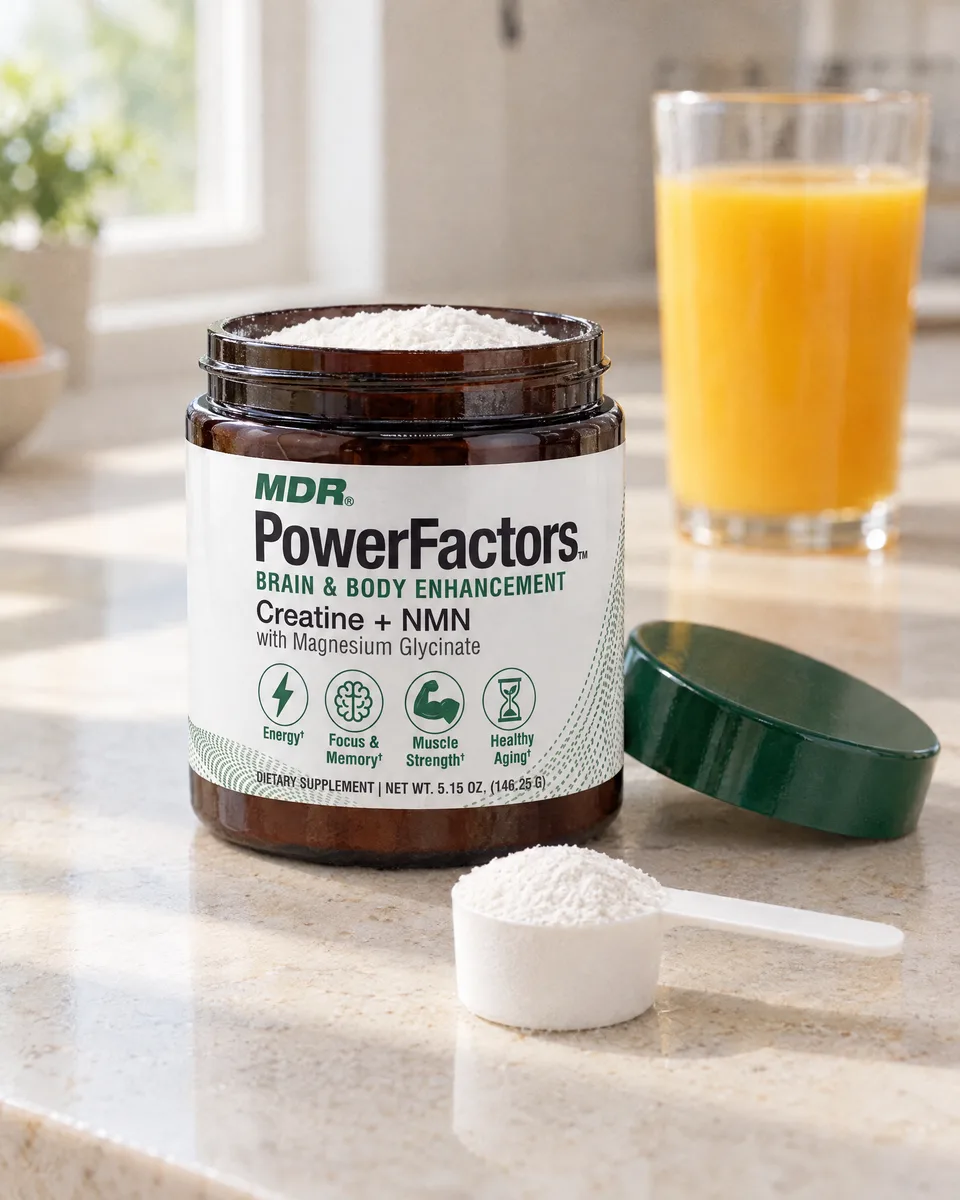
MDR PowerFactors is one level scoop a day with 5 grams of creatine monohydrate, 250 mg of NMN, 100 mg of elemental magnesium from magnesium bisglycinate and 100 mg of collagen peptides; the label lists 0 calories and 0 grams of sugar. Its label lists energy, focus and memory, muscle strength and healthy aging†. No clinical trial has tested the finished formula for any of these; the research we can point to is on the individual ingredients, as described above, and it is strongest for creatine and strength with training. It is for people who want creatine plus NMN in a single scoop stirred into juice or a protein shake, and who are comfortable that the combination itself has not been studied. If that isn't you, plain creatine is the better buy. The full label is on the PowerFactors report, and mixing and timing are covered in How to take creatine and NMN.
Last updated October 19, 2026.
Sources
- Chilibeck PD, Kaviani M, Candow DG, Zello GA. Effect of creatine supplementation during resistance training on lean tissue mass and muscular strength in older adults: a meta-analysis. Open Access J Sports Med. 2017;8:213-226. PubMed 29138605
- Prokopidis K, Moriarty F, Bahat G, et al. The effect of nicotinamide mononucleotide and riboside on skeletal muscle mass and function: a systematic review and meta-analysis. J Cachexia Sarcopenia Muscle. 2025;16(3):e13799. PubMed 40275690
- Igarashi M, Naruse K, Takaoka Y, et al. Sustained NAD+ augmentation by high-dose nicotinamide mononucleotide supplementation in older adults: a 24-week randomized, double-blind, placebo-controlled trial. npj Aging. 2026. doi:10.1038/s41514-026-00482-7
- Okabe K, Yaku K, Uchida Y, et al. Oral administration of nicotinamide mononucleotide is safe and efficiently increases blood nicotinamide adenine dinucleotide levels in healthy subjects. Front Nutr. 2022;9:868640. PubMed 35479740
- Sandkühler JF, Kersting X, Faust A, et al. The effects of creatine supplementation on cognitive performance: a randomised controlled study. BMC Med. 2023;21(1):440. PubMed 37968687
- Zdzieblik D, Oesser S, Baumstark MW, Gollhofer A, König D. Collagen peptide supplementation in combination with resistance training improves body composition and increases muscle strength in elderly sarcopenic men: a randomised controlled trial. Br J Nutr. 2015;114(8):1237-1245. PubMed 26353786
- Massudi H, Grant R, Braidy N, et al. Age-associated changes in oxidative stress and NAD+ metabolism in human tissue. PLoS One. 2012;7(7):e42357. PubMed 22848760
- NIH Office of Dietary Supplements. Magnesium: Fact Sheet for Health Professionals. ods.od.nih.gov
- NIH Office of Dietary Supplements. Dietary Supplements for Exercise and Athletic Performance: Fact Sheet for Health Professionals. ods.od.nih.gov
†These statements have not been evaluated by the Food and Drug Administration. This product is not intended to diagnose, treat, cure, or prevent any disease.