
Why Cycle a Supplement Five Days On, Two Days Off?
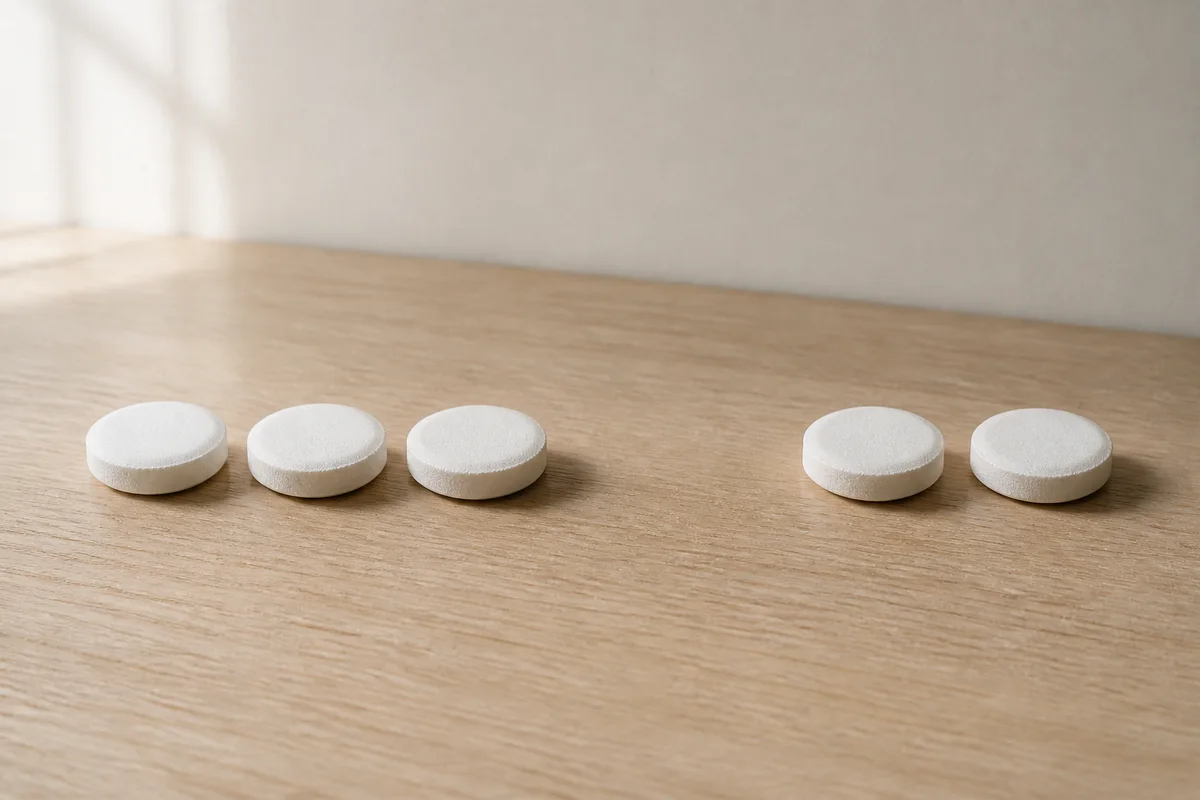
Cycling a supplement means taking it on a defined schedule with planned breaks rather than continuously. The rationale is that biological systems adapt to constant input, so a pause can limit that adaptation. Cycling is a considered formulation choice with a mechanistic basis; it has not been shown to produce better outcomes than daily use.
Nearly every supplement you can buy says the same thing on the back: take one daily. It is such a universal instruction that a label saying anything else tends to read like a mistake.
A small number of formulas are deliberately built the other way, a run of days on, then a short pause, repeating. VitalFactors is taken five days on, two days off. People ask why often enough that it is worth a proper answer.
What cycling is, and where the idea comes from
Cycling means taking something on a defined schedule with planned breaks, rather than continuously.
The practice is not new and it is not unique to supplements. It shows up wherever there is reason to think continuous exposure to a compound produces a different response over time than intermittent exposure. Two ideas sit behind it:
Receptor and pathway adaptation. Biological systems adjust to steady input. When a signal is constant, the body frequently adapts, regulating the number of receptors, or the activity of the enzymes involved. The most familiar everyday example is caffeine: the effect of a daily dose is not the effect of the first one, because the system has adjusted around it. A pause is one way of not letting that adaptation settle in.
Not everything works better simply for being constant. Some biological processes are rhythmic rather than steady. Providing a compound in pulses more closely resembles how it would arrive from food than a fixed daily dose does.
Both are reasonable mechanistic ideas. Neither is a proven rule that applies to every nutrient, and I would not want to suggest otherwise.
Being honest about the evidence
This is where cycling gets oversold, so let us be direct.
Cycling is well established in a few specific contexts where the compound clearly drives adaptation or tolerance. It is a plausible design choice for formulas built around actives that are more than basic vitamins and minerals. It is not established that cycling any given supplement produces a better outcome than taking it daily. The comparative trials that would settle that mostly have not been run.
So the accurate framing is that cycling is a considered formulation decision with a mechanistic rationale, not a proven superiority, and not something that makes a supplement work when it otherwise would not.
There is also a plain practical argument that gets less attention than it deserves: a two-day pause each week is simply less total intake. For a formula built around concentrated plant actives rather than basic nutrients, taking somewhat less of something over a long period is a conservative choice, not a compromise.
What cycling is not for
It is not a detox. Your liver and kidneys handle clearance continuously and do not need a scheduled break to do it.
It is not because the product is harsh. A pause built into the design is a formulation decision, not a warning label.
It does not apply to everything. Most basic vitamins and minerals are taken daily for good reason, you are topping up nutrients the body uses and excretes continuously. Cycling makes more sense for concentrated actives than for a plain multivitamin. If a label says daily, take it daily.
What effervescent changes
VitalFactors is also effervescent, two tablets dissolved in a glass of water rather than swallowed, and that is a separate design decision worth explaining on its own.
It is already in solution. A swallowed tablet has to disintegrate in the stomach before anything can be absorbed, and how completely and quickly that happens varies with the tablet's compression, its coating, and what else is in your stomach. An effervescent tablet has finished that step in the glass. What you drink is already dispersed.
It removes the swallowing problem. A large tablet is a genuine obstacle for a lot of people, and it is one of the most common reasons a supplement routine quietly stops. A drink is easier to keep up with.
It comes with water attached. Modest, but real: the format builds a glass of water into the routine.
The trade-off is honest enough, effervescent formats are bulkier, and they taste of something, which not everyone wants.
What is actually in it
VitalFactors is an age-defying nutritional complex built around four actives, VitalNAD⁺ (NMN, nicotinamide mononucleotide), resveratrol, EGCG and S.O.D., alongside a full panel of vitamins, minerals, amino acids and plant antioxidants.
It supports normal energy metabolism and helps support antioxidant protection. There is no caffeine in it, so the "energy" here is metabolic rather than stimulant, a distinction worth holding onto, and one we go into properly in choosing a multivitamin for energy.
Two tablets dissolve completely in a glass of water, taken five days on, two days off, not daily. That rhythm is the formulation, not a suggestion.
If the NAD⁺ part is what brought you here, what NAD⁺ actually is covers what the research does and does not establish about it.
These statements have not been evaluated by the Food and Drug Administration. This product is not intended to diagnose, treat, cure, or prevent any disease.