
How to Take Creatine and NMN: Timing, Mixing and What to Tell Your Doctor

Take about 5 grams of creatine once a day, at whatever time you will remember; for most people consistency matters far more than timing. Stir it into something you enjoy, such as orange juice or a protein shake, and drink it soon after mixing. You don't need a loading phase, and missing the odd day does little harm because muscle stores fall slowly. NMN can go in the same glass. Before blood work, tell your doctor you take creatine, because it can raise creatinine, the marker used to estimate kidney function.
Many questions about creatine and NMN are practical ones: when to take them, what to mix them into, and what to do on the day you forget. Here are our answers, with the research behind them.
Consistency beats timing
Creatine works by gradually filling your muscles' stores and keeping them full. In the classic biopsy study, 3 grams a day raised muscle creatine by about 20 percent over 28 days, the same level a high-dose loading week reached in six days (Hultman and colleagues, 1996). What matters is the steady daily amount over weeks, not the hour you take it.
Researchers have compared taking creatine before and after workouts. In a 32-week trial of adults aged 50 to 71 who lifted weights, creatine taken before or after training produced similar strength gains, both well ahead of placebo. Only the after-training group's lean mass gain was significantly larger than placebo's, but the trial did not show that after beats before (Candow and colleagues, 2015). Keep in mind that these benefits came with regular resistance training; taking creatine without training is a different situation. A review of common questions by a group of creatine researchers, published in 2021, concludes that you don't need to load, and that 3 to 5 grams a day is effective (Antonio and colleagues, 2021). If you train, taking it around your workout is an easy habit to attach it to. If you don't, breakfast works just as well.
What to mix it into
Juice or a protein shake. Both are easy, and there is some research on taking creatine with carbohydrate and protein.
In a 1996 study, men who took creatine with a large carbohydrate drink stored about 60 percent more creatine in muscle during a loading week than men who took creatine alone, an effect the researchers linked to insulin (Green and colleagues, 1996). A follow-up, measuring how much creatine the whole body retained, found that about 50 grams of protein with about 50 grams of carbohydrate raised retention about as much as nearly 100 grams of carbohydrate (Steenge and colleagues, 2000).
Those studies used much more carbohydrate than a normal glass of juice, over short loading periods. We don't claim your morning orange juice measurably boosts creatine uptake. The main reason to use juice or a shake is that it is something you already drink, which makes the habit easier to keep.
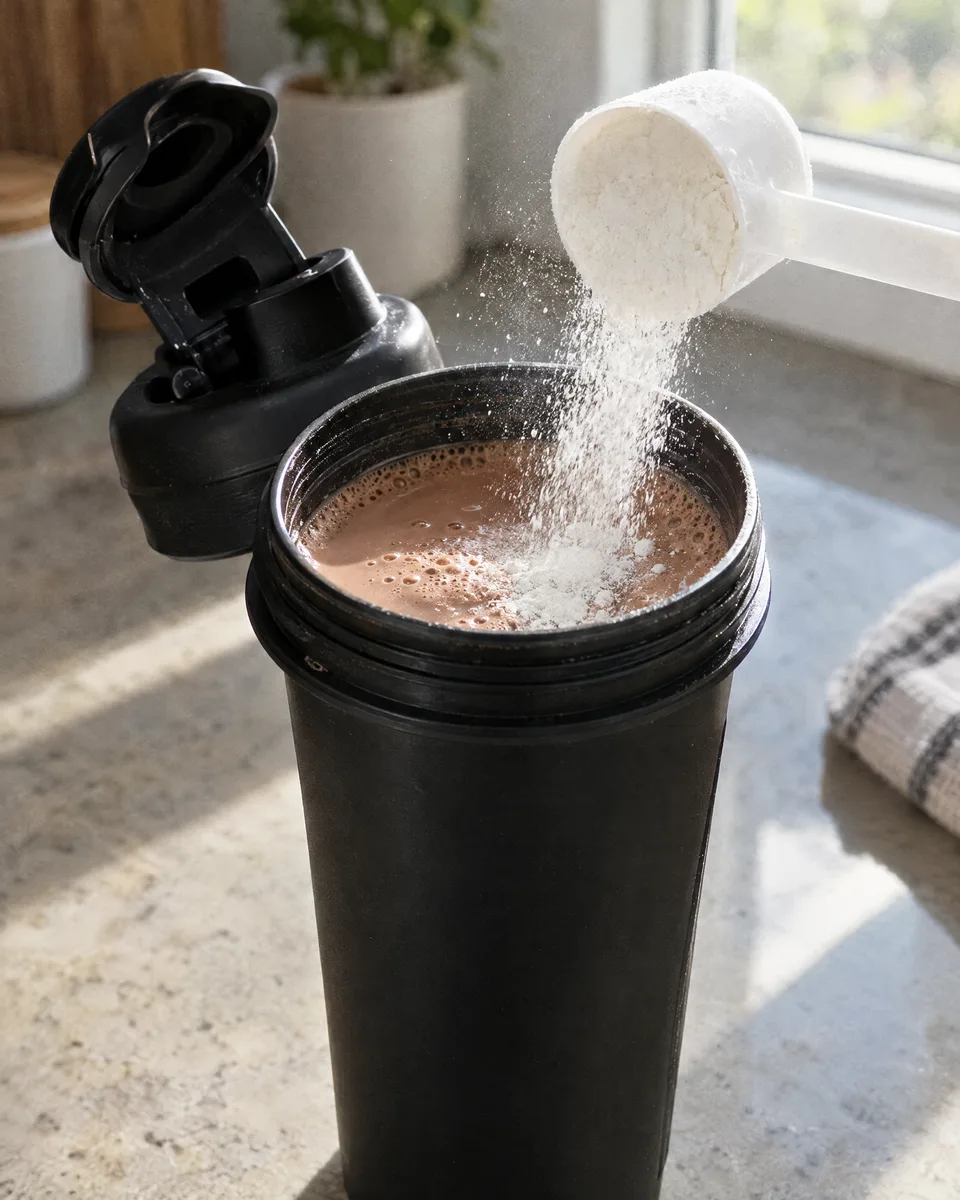
Mix it and drink it. Creatine powder is very stable on the shelf, but once it is in liquid it slowly converts to creatinine, faster when the drink is warm or acidic (Antonio and colleagues, 2021). So stir it in when you are ready to drink it rather than mixing a batch the night before, and if a drink is hot, drink it promptly.
Every day, or five days a week?
The direction on the PowerFactors label is one scoop a day, and daily is the simplest habit to keep. But you don't need to worry about a missed day or a weekend away.
Muscle creatine falls slowly. In the same 1996 biopsy study, stores took about 30 days to drift back to their starting level after people stopped taking it entirely (Hultman and colleagues, 1996). And a meta-analysis of older adults found that creatine taken only on resistance training days still improved lean mass and strength compared with placebo (Forbes and colleagues, 2021). As practical guidance: if you forget a day, just pick up again the next, and don't double up.
What about NMN?
In PowerFactors, NMN and creatine are already in the same scoop. If you take NMN separately, we found no good evidence that time of day matters. One 12-week trial in older adults found the largest improvements in a sit-to-stand test and in drowsiness in people who took NMN in the afternoon, but every group in that study, placebo included, improved on the sit-to-stand test, so it is not a reason to rearrange your day (Kim and colleagues, 2022). Our NMN article covers what the research does and does not show.
Magnesium and your medicines
If your creatine product also contains magnesium, as ours does, keep it apart from a few medicines that magnesium can bind to in the gut. Per the NIH, take oral osteoporosis tablets (bisphosphonates such as alendronate) at least 2 hours before or after magnesium, and take tetracycline or quinolone antibiotics at least 2 hours before or 4 to 6 hours after it (NIH Office of Dietary Supplements). More in our magnesium article.
What to tell your doctor
Three things are worth a mention at your next appointment.
1. That you take creatine, before any blood test. Your body turns creatine into creatinine, and doctors use blood creatinine to estimate how well your kidneys filter (the eGFR on your lab report). Creatine can raise creatinine slightly, about 0.13 mg/dL on average in a 2026 meta-analysis of randomized trials, without a statistically significant difference in urea or eGFR between groups (Tsiaras and colleagues, 2026). That small rise can still make a borderline result look worse than it is, and a real problem should never be put down to creatine without checking. If your doctor knows, they can interpret the number with that in mind or ask you to pause before a test.
2. Any kidney condition. The main safety conclusions for creatine are for healthy people (Antonio and colleagues, 2021), and impaired kidneys clear magnesium less well (NIH Office of Dietary Supplements). If you have kidney disease or reduced kidney function, ask before you start.
3. Your other supplements and prescriptions. Mention NMN, magnesium and anything else you take daily, especially oral osteoporosis tablets, antibiotics, diuretics or proton pump inhibitors for acid reflux. If you are pregnant or nursing, ask before taking any of these.
What we don't know yet
- Best time of day. We found no good evidence that morning or evening matters for either creatine or NMN in everyday use.
- Long-term NMN. The longest NMN trials we found ran 24 weeks.
- Whether a modest amount of carbohydrate helps. The uptake studies used very large amounts over short loading periods.
- Tolerability in you. Creatine can cause stomach upset in some people, more often with large single doses, and magnesium can loosen stools at higher doses.
Common questions
Should I take creatine before or after my workout?
Whichever you'll stick with. In older adults, both produced similar strength gains. The daily total matters more.
What if I miss a day?
Pick up again the next day. Muscle stores fall slowly over weeks, so one missed day changes very little. There is no need to take a double serving.
Can I mix it into hot coffee or tea?
Heat speeds up the breakdown of creatine in liquid, so if you do, drink it right away. We recommend juice or a protein shake, drunk soon after mixing.
Do I need to stop before a blood test?
Ask your doctor. The most important thing is that they know you take creatine, so a slightly higher creatinine reading is interpreted correctly.
Where PowerFactors fits
One level scoop of MDR PowerFactors gives you 5 grams of creatine monohydrate, 250 mg of NMN and 100 mg of elemental magnesium from magnesium bisglycinate, plus 100 mg of collagen peptides. Stir it into a glass of orange juice or your favorite protein shake, once a day. The powder is fine and white, and the label lists 0 calories and 0 grams of sugar per scoop. Each jar holds 25 servings, and the full panel is on the PowerFactors report. For the research on each ingredient, start with Creatine after 50.
Last updated October 19, 2026.
Sources
- Hultman E, Söderlund K, Timmons JA, Cederblad G, Greenhaff PL. Muscle creatine loading in men. J Appl Physiol. 1996;81(1):232-237. PubMed 8828669
- Antonio J, Candow DG, Forbes SC, et al. Common questions and misconceptions about creatine supplementation: what does the scientific evidence really show? J Int Soc Sports Nutr. 2021;18(1):13. PubMed 33557850
- Candow DG, Vogt E, Johannsmeyer S, Forbes SC, Farthing JP. Strategic creatine supplementation and resistance training in healthy older adults. Appl Physiol Nutr Metab. 2015;40(7):689-694. PubMed 25993883
- Green AL, Hultman E, Macdonald IA, Sewell DA, Greenhaff PL. Carbohydrate ingestion augments skeletal muscle creatine accumulation during creatine supplementation in humans. Am J Physiol. 1996;271(5 Pt 1):E821-E826. PubMed 8944667
- Steenge GR, Simpson EJ, Greenhaff PL. Protein- and carbohydrate-induced augmentation of whole body creatine retention in humans. J Appl Physiol. 2000;89(3):1165-1171. PubMed 10956365
- Forbes SC, Candow DG, Ostojic SM, Roberts MD, Chilibeck PD. Meta-analysis examining the importance of creatine ingestion strategies on lean tissue mass and strength in older adults. Nutrients. 2021;13(6):1912. PubMed 34199420
- Kim M, Seol J, Sato T, et al. Effect of 12-week intake of nicotinamide mononucleotide on sleep quality, fatigue, and physical performance in older Japanese adults. Nutrients. 2022;14(4):755. PubMed 35215405
- Tsiaras A, et al. The effect of creatine supplementation on kidney function: a systematic review and meta-analysis of randomized controlled trials. J Ren Nutr. 2026. PubMed 42035842
- NIH Office of Dietary Supplements. Magnesium: Fact Sheet for Health Professionals. ods.od.nih.gov
†These statements have not been evaluated by the Food and Drug Administration. This product is not intended to diagnose, treat, cure, or prevent any disease.